Next: Introduction, Up: (dir) [Contents][Index]
GNU Simple Authentication and Security Layer
This manual was last updated 2 January 2024 for version 2.2.1 of GNU SASL.
Copyright © 2002–2024 Simon Josefsson.
Permission is granted to copy, distribute and/or modify this document under the terms of the GNU Free Documentation License, Version 1.3 or any later version published by the Free Software Foundation; with no Invariant Sections, no Front-Cover Texts, and no Back-Cover Texts. A copy of the license is included in the section entitled “GNU Free Documentation License”.
Table of Contents
- 1 Introduction
- 2 Preparation
- 3 Using the Library
- 4 Properties
- 5 Mechanisms
- 5.1 The EXTERNAL mechanism
- 5.2 The ANONYMOUS mechanism
- 5.3 The PLAIN mechanism
- 5.4 The LOGIN mechanism
- 5.5 The CRAM-MD5 mechanism
- 5.6 The DIGEST-MD5 mechanism
- 5.7 The SCRAM mechanisms
- 5.8 The NTLM mechanism
- 5.9 The SECURID mechanism
- 5.10 The GSSAPI mechanism
- 5.11 The GS2-KRB5 mechanism
- 5.12 The SAML20 mechanism
- 5.13 The OPENID20 mechanism
- 6 Global Functions
- 7 Callback Functions
- 8 Property Functions
- 9 Session Functions
- 10 Utilities
- 11 Memory Handling
- 12 Error Handling
- 13 Examples
- 14 Acknowledgements
- 15 Invoking gsasl
- Appendix A Protocol Clarifications
- Appendix B Copying Information
- Function and Data Index
- Concept Index
Next: Preparation, Previous: GNU Simple Authentication and Security Layer, Up: GNU Simple Authentication and Security Layer [Contents][Index]
1 Introduction
GNU SASL is an implementation of the Simple Authentication and Security Layer (SASL) framework and a few common SASL mechanisms. SASL is used by network servers (e.g., IMAP, SMTP, XMPP) to request authentication from clients, and in clients to authenticate against servers.
GNU SASL consists of a C library (libgsasl), a command-line application (gsasl), and a manual. The library supports the ANONYMOUS, CRAM-MD5, DIGEST-MD5, EXTERNAL, GS2-KRB5, GSSAPI, LOGIN, NTLM, OPENID20, PLAIN, SCRAM-SHA-1, SCRAM-SHA-1-PLUS, SCRAM-SHA-256, SCRAM-SHA-256-PLUS, SAML20, and SECURID mechanisms.
This manual can be used in several ways. If read from the beginning to the end, it gives the reader an understanding of the SASL framework and the GNU SASL implementation, and how the GNU SASL library is used in an application. Forward references are included where necessary. Later on, the manual can be used as a reference manual to get just the information needed about any particular interface of the library. Experienced programmers might want to start looking at the examples at the end of the manual, and then only read up those parts of the interface which are unclear.
- SASL Overview
- Implementation
- Features
- Requirements
- Supported Platforms
- Getting help
- Commercial Support
- Downloading and Installing
- Bug Reports
- Contributing
Next: Implementation, Up: Introduction [Contents][Index]
1.1 SASL Overview
SASL is a framework for application protocols, such as SMTP or IMAP, to add authentication support. For example, SASL is used to prove to the server who you are when you access an IMAP server to read your e-mail.
The SASL framework does not specify the technology used to perform the authentication, that is the responsibility for each SASL mechanism. Popular SASL mechanisms include CRAM-MD5 and GSSAPI (for Kerberos V5).
Typically a SASL negotiation works as follows. First the client requests authentication (possibly implicitly by connecting to the server). The server responds with a list of supported mechanisms. The client chose one of the mechanisms. The client and server then exchange data, one round-trip at a time, until authentication either succeeds or fails. After that, the client and server knows more about who is on the other end of the channel.
For example, in SMTP communication happens like this:
250-mail.example.com Hello pc.example.org [192.168.1.42], pleased to meet you
250-AUTH DIGEST-MD5 CRAM-MD5 LOGIN PLAIN
250 HELP
AUTH CRAM-MD5
334 PDk5MDgwNDEzMDUwNTUyMTE1NDQ5LjBAbG9jYWxob3N0Pg==
amFzIDBkZDRkODZkMDVjNjI4ODRkYzc3OTcwODE4ZGI5MGY3
235 2.0.0 OK Authenticated
Here the first three lines are sent by the server and contains the list of supported mechanisms (DIGEST-MD5, CRAM-MD5, etc). The next line is sent by the client to select the CRAM-MD5 mechanism. The server replies with a challenge, which is a message that can be generated by calling GNU SASL functions. The client replies with a response, which also is a message that can be generated by GNU SASL functions. Depending on the mechanism, there can be more than one round trip, so do not assume all authentication exchanges consists of one message from the server and one from the client. The server accepts the authentication. At that point it knows it is talking to a authenticated client, and the application protocol can continue.
Essentially, your application is responsible for implementing the framing protocol (e.g., SMTP or XMPP) according to the particular specifications. Your application uses GNU SASL to generate the authentication messages.
Next: Features, Previous: SASL Overview, Up: Introduction [Contents][Index]
1.2 Implementation
The library is easily ported because it does not do network communication by itself, but rather leaves it up to the calling application. The library is flexible with regards to the authorization infrastructure used, as it utilizes a callback into the application to decide whether a user is authorized or not.
GNU SASL is developed for the GNU/Linux system, but runs on over 20 platforms including most major Unix platforms and Windows, and many kind of devices including iPAQ handhelds and S/390 mainframes.
GNU SASL is written in pure ANSI C89 to be portable to embedded and otherwise limited platforms. The entire library, with full support for ANONYMOUS, EXTERNAL, PLAIN, LOGIN and CRAM-MD5, and the front-end that supports client and server mode, and the IMAP and SMTP protocols, fits in under 80kb on an Intel x86 platform, without any modifications to the code. (This figure was accurate as of version 1.1.)
The design of the library and the intended interaction between applications and the library through the official API is illustrated below.
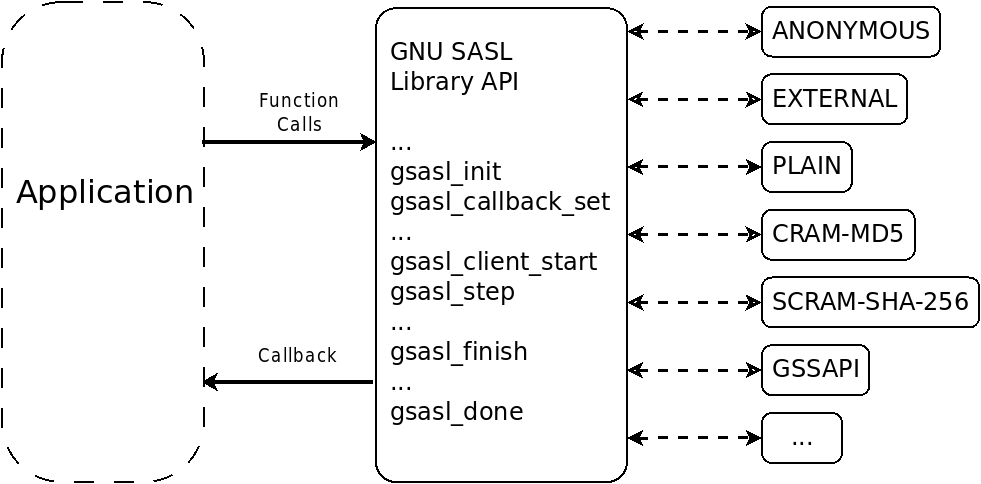
Illustration 1.1: Logical overview showing how applications use authentication mechanisms through an abstract interface.
Next: Requirements, Previous: Implementation, Up: Introduction [Contents][Index]
1.3 Features
GNU SASL might have a couple of advantages over other libraries doing a similar job.
- It’s Free Software
Anybody can use, modify, and redistribute it under the terms of the GNU General Public License version 3.0 or later. The library uses the GNU Lesser General Public License version 2.1 or later.
- It’s thread-safe
No global variables are used and multiple library handles and session handles may be used in parallel.
- It’s internationalized
It handles non-ASCII usernames and passwords and user visible strings used in the library (error messages) can be translated into the users’ language.
- It’s portable
It should work on all Unix like operating systems, including Windows. The library itself should be portable to any C89 system, not even POSIX is required.
- It’s small
The library has been rewritten with embedded platforms in mind. For example, no API consumes more than around 250 bytes of stack space.
Note that the library does not implement any policy to decide whether a certain user is “authenticated” or “authorized” or not. Rather, it uses a callback into the application to answer these questions.
Next: Supported Platforms, Previous: Features, Up: Introduction [Contents][Index]
1.4 Requirements
The GNU SASL library does not have any required external dependencies, but some optional features are enabled if you have a specific external library.
- LibNTLM
The NTLM mechanism requires the library LibNTLM, https://www.nongnu.org/libntlm/.
- GSS-API
The GSSAPI and GS2-KRB5 mechanisms requires a GSS-API library, see GNU GSS (https://www.gnu.org/software/gss/). Libgssglue, MIT Kerberos, and Heimdal are also supported. You are encouraged to try Libgssglue (https://blog.josefsson.org/2022/07/14/towards-pluggable-gss-api-modules/).
- LibIDN
Processing of non-ASCII usernames and passwords requires the SASLprep implementation in LibIDN (https://www.gnu.org/software/libidn/). This is needed for full conformance with the latest SASL protocol drafts, but is optional in the library for improved portability.
- Libgcrypt
The GNU SASL library ships with its own cryptographic implementation, but it can use the one in libgcrypt (https://www.gnupg.org/) instead, if it is available. This is typically useful for desktop machines which have libgcrypt installed.
The command-line interface to GNU SASL requires a POSIX or Windows platform for network connectivity. The command-line tool can make use of GnuTLS (https://www.gnutls.org/) to support the STARTTLS modes of IMAP and SMTP, but GnuTLS is not required.
Note that the library does not need a POSIX platform or network connectivity.
Next: Getting help, Previous: Requirements, Up: Introduction [Contents][Index]
1.5 Supported Platforms
GNU SASL has at some point in time been tested on the following platforms.
- Debian GNU/Linux
GCC and GNU Make. This is the main development platform.
x86_64-linux-gnu,alphaev67-unknown-linux-gnu,alphaev6-unknown-linux-gnu,arm-unknown-linux-gnu,hppa-unknown-linux-gnu,hppa64-unknown-linux-gnu,i686-pc-linux-gnu,ia64-unknown-linux-gnu,m68k-unknown-linux-gnu,mips-unknown-linux-gnu,mipsel-unknown-linux-gnu,powerpc-unknown-linux-gnu,s390-ibm-linux-gnu,sparc-unknown-linux-gnu,armv4l-unknown-linux-gnu. - Tru64 UNIX
Tru64 UNIX C compiler and Tru64 Make.
alphaev67-dec-osf5.1,alphaev68-dec-osf5.1. - SuSE Linux 7.1
GCC 2.96 and GNU Make.
alphaev6-unknown-linux-gnu,alphaev67-unknown-linux-gnu. - SuSE Linux 7.2a
GCC 3.0 and GNU Make.
ia64-unknown-linux-gnu. - RedHat Linux 7.2
GCC 2.96 and GNU Make.
alphaev6-unknown-linux-gnu,alphaev67-unknown-linux-gnu,ia64-unknown-linux-gnu. - RedHat Linux 8.0
GCC 3.2 and GNU Make.
i686-pc-linux-gnu. - RedHat Advanced Server 2.1
GCC 2.96 and GNU Make.
i686-pc-linux-gnu. - Slackware Linux 8.0.01
GCC 2.95.3 and GNU Make.
i686-pc-linux-gnu. - Mandrake Linux 9.0
GCC 3.2 and GNU Make.
i686-pc-linux-gnu. - IRIX 6.5
MIPS C compiler, IRIX Make.
mips-sgi-irix6.5. - AIX 4.3.2
IBM C for AIX compiler, AIX Make.
rs6000-ibm-aix4.3.2.0. - Microsoft Windows 2000 (Cygwin)
GCC 3.2, GNU make.
i686-pc-cygwin. - HP-UX 11
HP-UX C compiler and HP Make.
ia64-hp-hpux11.22,hppa2.0w-hp-hpux11.11. - SUN Solaris 2.8
Sun WorkShop Compiler C 6.0 and SUN Make.
sparc-sun-solaris2.8. - SUN Solaris 2.9
Sun Forte Developer 7 C compiler and GNU Make.
sparc-sun-solaris2.9. - NetBSD 1.6
GCC 2.95.3 and GNU Make.
alpha-unknown-netbsd1.6,i386-unknown-netbsdelf1.6. - OpenBSD 3.1 and 3.2
GCC 2.95.3 and GNU Make.
alpha-unknown-openbsd3.1,i386-unknown-openbsd3.1. - FreeBSD 4.7
GCC 2.95.4 and GNU Make.
alpha-unknown-freebsd4.7,i386-unknown-freebsd4.7. - Cross compiled to uClinux/uClibc on Motorola Coldfire.
GCC 3.4 and GNU Make
m68k-uclinux-elf.
If you port GNU SASL to a new platform, please report it to the author so this list can be updated.
Next: Commercial Support, Previous: Supported Platforms, Up: Introduction [Contents][Index]
1.6 Getting help
A mailing list where users may help each other exists, and you can reach it by sending e-mail to help-gsasl@gnu.org. Archives of the mailing list discussions, and an interface to manage subscriptions, is available through the World Wide Web at https://lists.gnu.org/mailman/listinfo/help-gsasl/.
Next: Downloading and Installing, Previous: Getting help, Up: Introduction [Contents][Index]
1.7 Commercial Support
Commercial support is available for users of GNU SASL. The kind of support that can be purchased may include:
- Implement new features. Such as a new SASL mechanism.
- Port GNU SASL to new platforms. This could include porting to an embedded platforms that may need memory or size optimization.
- Integrating SASL as a security environment in your existing project.
- System design of components related to SASL.
The following companies have expressed an interest in providing this support:
- Simon Josefsson Datakonsult AB
Contact through https://josefsson.org/ and email simon@josefsson.org.
If your company provides support related to GNU SASL and would like to be mentioned here, please let us know (see Bug Reports).
Next: Bug Reports, Previous: Commercial Support, Up: Introduction [Contents][Index]
1.8 Downloading and Installing
The package can be downloaded from several places, including:
https://ftp.gnu.org/gnu/gsasl/
The latest version is stored in a file, e.g., ‘gsasl-2.2.1.tar.gz’ where the ‘2.2.1’ value is the highest version number in the directory.
The package is then extracted, configured and built like many other packages that use Autoconf. For detailed information on configuring and building it, refer to the INSTALL file that is part of the distribution archive.
Here is an example terminal session that downloads, configures, builds and install the package. You will need a few basic tools, such as ‘sh’, ‘make’ and ‘cc’.
$ wget -q https://ftp.gnu.org/gnu/gsasl/gsasl-2.2.1.tar.gz
$ tar xfz gsasl-2.2.1.tar.gz
$ cd gsasl-2.2.1/
$ ./configure
...
$ make
...
$ make install
...
After that gsasl should be properly installed and ready for use.
A few configure options may be relevant, summarized in the
table.
--disable-client--disable-serverIf your target system require a minimal implementation, you may wish to disable the client or the server part of the code. This does not remove symbols from the library, so if you attempt to call an application that uses server functions in a library built with
--disable-server, the function will return an error code.--disable-anonymous--disable-external--disable-plain--disable-login--disable-securid--disable-ntlm--disable-cram-md5--disable-digest-md5--disable-gssapi--disable-gs2--disable-scram-sha1--disable-scram-sha256--disable-saml20--disable-openid20Disable or enable individual mechanisms (see Mechanisms).
--without-stringprepDisable internationalized string processing. Note that this will result in a SASL library that is compatible with RFC 2222 but not RFC 4422.
For the complete list, refer to the output from configure
--help.
Next: Kerberos on Windows, Up: Downloading and Installing [Contents][Index]
1.8.1 Installing under Windows
There are two ways to build GNU SASL on Windows: via MinGW or via Microsoft Visual Studio. Note that a binary release for Windows is available from http://josefsson.org/gnutls4win/.
With MinGW, you can build a GNU SASL DLL and use it from other applications. After installing MinGW (http://mingw.org/) follow the generic installation instructions (see Downloading and Installing). The DLL is installed by default.
For information on how to use the DLL in other applications, see: http://www.mingw.org/mingwfaq.shtml#faq-msvcdll.
You can build GNU SASL as a native Visual Studio C++ project. This allows you to build the code for other platforms that VS supports, such as Windows Mobile. You need Visual Studio 2005 or later.
First download and unpack the archive as described in the generic
installation instructions (see Downloading and Installing). Don’t
run ./configure. Instead, start Visual Studio and open the
project file lib/win32/libgsasl.sln inside the GNU SASL
directory. You should be able to build the project using Build
Project.
Output libraries will be written into the lib/win32/lib (or
lib/win32/lib/debug for Debug versions) folder.
Warning! Unless you build GNU SASL linked with libgcrypt, GNU SASL
uses the Windows function CryptGenRandom for generating
cryptographic random data. The function is known to have some
security weaknesses. See http://eprint.iacr.org/2007/419 for
more information. The code will attempt to use the Intel RND crypto
provider if it is installed, see lib/gl/gc-gnulib.c.
Previous: Installing under Windows, Up: Downloading and Installing [Contents][Index]
1.8.2 Kerberos on Windows
Building GNU SASL with support for Kerberos via GSS-API on Windows is straight forward if you use GNU GSS and GNU Shishi as the Kerberos implementation.
If you are using MIT Kerberos for Windows (KfW), getting GNU SASL to build with Kerberos support is not straightforward because KfW does not follow the GNU coding style and it has bugs that needs to be worked around. We provide instructions for this environment as well, in the hope that it will be useful for GNU SASL users.
Our instructions assumes you are building the software on a dpkg-based GNU/Linux systems (e.g., gNewSense) using the MinGW cross-compiler suite. These instructions were compiled for KfW version 3.2.2 which were the latest as of 2010-09-25.
We assume that you have installed a normal build environment including the MinGW cross-compiler. Download and unpack the KfW SDK like this:
$ mkdir ~/kfw
$ cd ~/kfw
$ wget -q http://web.mit.edu/kerberos/dist/kfw/3.2/kfw-3.2.2/kfw-3-2-2-sdk.zip
$ unzip kfw-3-2-2-sdk.zip
Fix a bug in the "win-mac.h" header inside KfW by replacing
#include <sys\foo.h> with #include <sys/foo.h>:
perl -pi -e 's,sys\\,sys/,' ~/kfw/kfw-3-2-2-final/inc/krb5/win-mac.h
Unpack your copy of GNU SASL:
$ wget -q ftp://alpha.gnu.org/gnu/gsasl/gsasl-2.2.1.tar.gz
$ tar xfz gsasl-2.2.1.tar.gz
$ cd gsasl-2.2.1
Configure GNU SASL like this:
$ lt_cv_deplibs_check_method=pass_all ./configure --host=i586-mingw32msvc --build=i686-pc-linux-gnu --with-gssapi-impl=kfw LDFLAGS="-L$HOME/kfw/kfw-3-2-2-final/lib/i386" CPPFLAGS="-I$HOME/kfw/kfw-3-2-2-final/inc/krb5 -DSSIZE_T_DEFINED"
The ’lt_cv_deplibs_check_method=pass_all’ setting is required because
the KfW SDK does not ship with Libtool *.la files and is using
non-standard DLL names. The -DSSIZE_T_DEFINED is necessary
because the win-mac.h file would provide an incorrect duplicate
definitions of ssize_t otherwise. By passing
--with-gssapi-impl=kfw you activate other bug workarounds, such
as providing a GSS_C_NT_HOSTBASED_SERVICE symbol.
Build the software using:
$ make
If you have Wine installed and your kernel is able to invoke it automatically for Windows programs, you can run the self tests. This is recommended to make sure the build is sane.
$ make check
You may get error messages about missing DLLs, like this error:
err:module:import_dll Library gssapi32.dll (which is needed by L"Z:\\home\\jas\\src\\gsasl-1.5.2\\lib\\src\\.libs\\libgsasl-7.dll") not found
If that happens, you need to make sure that Wine can find the
appropriate DLL. The simplest solution is to copy the necessary DLLs
to ~/.wine/drive_c/windows/system32/.
You may now copy the following files onto the Windows machine (e.g., through a USB memory device):
lib/src/.libs/libgsasl-7.dll
src/.libs/gsasl.exe
The remaining steps are done on the Windows XP machine. Install KfW and configure it for your realm. To make sure KfW is working properly, acquire a user ticket and then remove it. For testing purposes, you may use the realm ’interop.josefsson.org’ with KDC ’interop.josefsson.org’ and username ’user’ and password ’pass’.
Change to the directory where you placed the files above, and invoke a command like this:
gsasl.exe -d interop.josefsson.org
KfW should query you for a password, and the tool should negotiate authentication against the server using GS2-KRB5.
Next: Contributing, Previous: Downloading and Installing, Up: Introduction [Contents][Index]
1.9 Bug Reports
If you think you have found a bug in GNU SASL, please investigate it and report it.
- Please make sure that the bug is really in GNU SASL, and preferably also check that it hasn’t already been fixed in the latest version.
- You have to send us a test case that makes it possible for us to reproduce the bug.
- You also have to explain what is wrong; if you get a crash, or if the results printed are not good and in that case, in what way. Make sure that the bug report includes all information you would need to fix this kind of bug for someone else.
Please make an effort to produce a self-contained report, with something definite that can be tested or debugged. Vague queries or piecemeal messages are difficult to act on and don’t help the development effort.
If your bug report is good, we will do our best to help you to get a corrected version of the software; if the bug report is poor, we won’t do anything about it (apart from asking you to send better bug reports).
If you think something in this manual is unclear, or downright incorrect, or if the language needs to be improved, please also send a note.
Send your bug report to:
Previous: Bug Reports, Up: Introduction [Contents][Index]
1.10 Contributing
If you want to submit a patch for inclusion – from solve a typo you discovered, up to adding support for a new feature – you should submit it as a bug report (see Bug Reports). There are some things that you can do to increase the chances for it to be included in the official package.
Unless your patch is very small (say, under 10 lines) we require that you assign the copyright of your work to the Free Software Foundation. This is to protect the freedom of the project. If you have not already signed papers, we will send you the necessary information when you submit your contribution.
For contributions that doesn’t consist of actual programming code, the only guidelines are common sense. Use it.
For code contributions, a number of style guides will help you:
- Coding Style.
Follow the GNU Standards document (see (standards)GNU Coding Standards).
If you normally code using another coding standard, there is no problem, but you should use ‘indent’ to reformat the code (see (indent)GNU Indent) before submitting your work.
- Use the unified diff format ‘diff -u’.
- Return errors.
No reason whatsoever should abort the execution of the library. Even
memory allocation errors, e.g. when
mallocreturnNULL, should work although result in an error code. - Design with thread safety in mind. Don’t use global variables. Don’t even write to per-handle global variables unless the documented behaviour of the function you write is to write to the per-handle global variable.
- Avoid using the C math library. It causes problems for embedded implementations, and in most situations it is very easy to avoid using it.
- Document your functions. Use comments before each function headers, that, if properly formatted, are extracted into Texinfo manuals and GTK-DOC web pages.
- Supply a ChangeLog and NEWS entries, where appropriate.
Next: Using the Library, Previous: Introduction, Up: GNU Simple Authentication and Security Layer [Contents][Index]
2 Preparation
To use GNU SASL, you have to perform some changes to your sources and the build system. The necessary changes are small and explained in the following sections. At the end of this chapter, it is described how the library is initialized, and how the requirements of the library are verified.
A faster way to find out how to adapt your application for use with GNU SASL may be to look at the examples at the end of this manual (see Examples).
Next: Initialization, Up: Preparation [Contents][Index]
2.1 Header
All interfaces (data types and functions) of the library are defined
in the header file gsasl.h. You must include this in all
programs using the library, either directly or through some other
header file, like this:
#include <gsasl.h>
The name space is gsasl_* for function names, Gsasl* for
data types and GSASL_* for other symbols. In addition the same
name prefixes with one prepended underscore are reserved for internal
use and should never be used by an application.
Next: Version Check, Previous: Header, Up: Preparation [Contents][Index]
2.2 Initialization
The library must be initialized before it can be used. The library is
initialized by calling gsasl_init (see Global Functions).
The resources allocated by the initialization process can be released
if the application no longer has a need to call ‘Libgsasl’ functions,
this is done by calling gsasl_done. For example:
int
main (int argc, char *argv[])
{
  Gsasl *ctx = NULL;
  int rc;
...
  rc = gsasl_init (&ctx);
  if (rc != GSASL_OK)
    {
      printf ("SASL initialization failure (%d): %s\n",
              rc, gsasl_strerror (rc));
      return 1;
    }
...
In order to make error messages from gsasl_strerror be
translated (see GNU Gettext) the application must
set the current locale using setlocale before calling
gsasl_init. For example:
int
main (int argc, char *argv[])
{
  Gsasl *ctx = NULL;
  int rc;
...
  setlocale (LC_ALL, "");
...
  rc = gsasl_init (&ctx);
  if (rc != GSASL_OK)
    {
      printf (gettext ("SASL initialization failure (%d): %s\n"),
              rc, gsasl_strerror (rc));
      return 1;
    }
...
In order to take advantage of the secure memory features in Libgcrypt1, you need to initialize secure memory in your application, and for some platforms even make your application setuid root. See the Libgcrypt documentation for more information. Here is example code to initialize secure memory in your code:
#include <gcrypt.h>
...
int
main (int argc, char *argv[])
{
  Gsasl *ctx = NULL;
  int rc;
...
  /* Check version of libgcrypt. */
  if (!gcry_check_version (GCRYPT_VERSION))
    die ("version mismatch\n");

  /* Allocate a pool of 16k secure memory.  This also drops priviliges
     on some systems. */
  gcry_control (GCRYCTL_INIT_SECMEM, 16384, 0);

  /* Tell Libgcrypt that initialization has completed. */
  gcry_control (GCRYCTL_INITIALIZATION_FINISHED, 0);
...
  rc = gsasl_init (&ctx);
  if (rc != GSASL_OK)
    {
      printf ("SASL initialization failure (%d): %s\n",
              rc, gsasl_strerror (rc));
      return 1;
    }
...
If you do not do this, keying material will not be allocated in secure memory (which, for most applications, is not the biggest secure problem anyway). Note that the GNU SASL Library has not been audited to make sure it stores passwords or keys in secure memory.
Next: Building the source, Previous: Initialization, Up: Preparation [Contents][Index]
2.3 Version Check
It is often desirable to check that the version of the library used is indeed one which fits all requirements. Even with binary compatibility, new features may have been introduced but, due to problem with the dynamic linker, an old version may actually be used. So you may want to check that the version is okay right after program startup.
gsasl_check_version
- Function: const char * gsasl_check_version (const char * req_version) 
req_version: version string to compare with, or NULL.
Check GNU SASL Library version.
See
GSASL_VERSIONfor a suitablereq_versionstring.This function is one of few in the library that can be used without a successful call to
gsasl_init().Return value: Check that the version of the library is at minimum the one given as a string in
req_versionand return the actual version string of the library; return NULL if the condition is not met. If NULL is passed to this function no check is done and only the version string is returned.
The normal way to use the function is to put something similar to the
following early in your main:
  if (!gsasl_check_version (GSASL_VERSION))
    {
      printf ("gsasl_check_version failed:\n"
              "Header file incompatible with shared library.\n");
      exit(1);
    }
Next: Autoconf tests, Previous: Version Check, Up: Preparation [Contents][Index]
2.4 Building the source
If you want to compile a source file including the gsasl.h header file, you must make sure that the compiler can find it in the directory hierarchy. This is accomplished by adding the path to the directory in which the header file is located to the compilers include file search path (via the -I option).
However, the path to the include file is determined at the time the
source is configured. To solve this problem, the library uses the
external package pkg-config that knows the path to the
include file and other configuration options. The options that need
to be added to the compiler invocation at compile time are output by
the --cflags option to pkg-config libgsasl. The
following example shows how it can be used at the command line:
gcc -c foo.c `pkg-config libgsasl --cflags`
Adding the output of ‘pkg-config libgsasl --cflags’ to the compiler command line will ensure that the compiler can find the gsasl.h header file.
A similar problem occurs when linking the program with the library.
Again, the compiler has to find the library files. For this to work,
the path to the library files has to be added to the library search
path (via the -L option). For this, the option
--libs to pkg-config libgsasl can be used. For
convenience, this option also outputs all other options that are
required to link the program with the library (for instance, the
‘-lidn’ option). The example shows how to link foo.o with
the library to a program foo.
gcc -o foo foo.o `pkg-config libgsasl --libs`
Of course you can also combine both examples to a single command by
specifying both options to pkg-config:
gcc -o foo foo.c `pkg-config libgsasl --cflags --libs`
Previous: Building the source, Up: Preparation [Contents][Index]
2.5 Autoconf tests
If you work on a project that uses Autoconf (see (autoconf)GNU Autoconf) to help find installed libraries, the suggestions in the previous section are not the entire story. There are a few methods to detect and incorporate the GNU SASL Library into your Autoconf based package. The preferred approach, is to use Libtool in your project, and use the normal Autoconf header file and library tests.
2.5.1 Autoconf test via ‘pkg-config’
If your audience is a typical GNU/Linux desktop, you can often assume they have the ‘pkg-config’ tool installed, in which you can use its Autoconf M4 macro to find and set up your package for use with Libgsasl. The following example illustrates this scenario.
AC_ARG_ENABLE(gsasl,
  AC_HELP_STRING([--disable-gsasl], [don't use GNU SASL]),
  gsasl=$enableval)
if test "$gsasl" != "no" ; then
  PKG_CHECK_MODULES(GSASL, libgsasl >= 2.2.1,
    [gsasl=yes],
    [gsasl=no])
  if test "$gsasl" != "yes" ; then
    gsasl=no
    AC_MSG_WARN([Cannot find GNU SASL, disabling])
  else
    gsasl=yes
    AC_DEFINE(USE_GSASL, 1, [Define to 1 if you want GNU SASL.])
  fi
fi
AC_MSG_CHECKING([if GNU SASL should be used])
AC_MSG_RESULT($gsasl)
2.5.2 Standalone Autoconf test using Libtool
If your package uses Libtool (see (libtool)GNU Libtool), you can use the normal Autoconf tests to find Libgsasl and rely on the Libtool dependency tracking to include the proper dependency libraries (e.g., Libidn). The following example illustrates this scenario.
AC_CHECK_HEADER(gsasl.h,
  AC_CHECK_LIB(gsasl, gsasl_check_version,
    [gsasl=yes AC_SUBST(GSASL_LIBS, -lgsasl)],
    gsasl=no),
  gsasl=no)
AC_ARG_ENABLE(gsasl,
  AC_HELP_STRING([--disable-gsasl], [don't use GNU SASL]),
  gsasl=$enableval)
if test "$gsasl" != "no" ; then
  AC_DEFINE(USE_SASL, 1, [Define to 1 if you want GNU SASL.])
else
  AC_MSG_WARN([Cannot find GNU SASL, diabling])
fi
AC_MSG_CHECKING([if GNU SASL should be used])
AC_MSG_RESULT($gsasl)
Next: Properties, Previous: Preparation, Up: GNU Simple Authentication and Security Layer [Contents][Index]
3 Using the Library
Your application’s use of the library can be roughly modeled into the following steps: initialize the library, optionally specify the callback, perform the authentication, and finally clean up. The following image illustrates this.
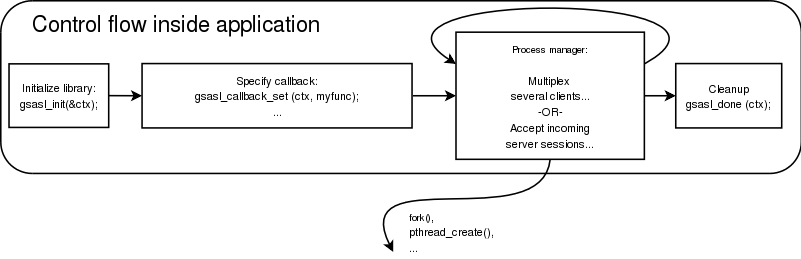
The third step may look complex, but for a simple client it will actually not involve any code. If your application needs to handle several concurrent clients, or if it is a server that needs to serve many clients simultaneous, things do get a bit more complicated.
For illustration, we will write a simple client. Writing a server
would be similar, the only difference is that, later on, instead of
supplying a username and password, you need to decide whether someone
should be allowed to log in or not. The code for what we have
discussed so far make up the main function in our client
(see Example 1):
int main (int argc, char *argv[])
{
  Gsasl *ctx = NULL;
  int rc;

  if ((rc = gsasl_init (&ctx)) != GSASL_OK)
    {
      printf ("Cannot initialize libgsasl (%d): %s",
              rc, gsasl_strerror (rc));
      return 1;
    }

  client (ctx);

  gsasl_done (ctx);

  return 0;
}
Here, the call to the function client correspond to the third
step in the image above.
For a more complicated application, having several clients running
simultaneous, instead of a simple call to client, it may have
created new threads for each session, and call client within
each thread. The library is thread safe.
An actual authentication session is more complicated than what we have seen so far. These are the steps: decide which mechanism to use, start the session, optionally specify the callback, optionally set any properties, perform the authentication loop, and clean up. Naturally, your application will start to talk its own protocol (e.g., SMTP or IMAP) after these steps have concluded.
The authentication loop is based on sending tokens (typically short messages encoded in base 64) back and forth between the client and server. It continues until authentication succeeds or an error occurs. The format of the data to be transferred, the number of iterations in the loop, and other details are specified by each mechanism. The goal of the library is to isolate your application from the details of all different mechanisms.
Note that the library does not send data to the server itself, but returns it in an buffer. You must send it to the server, following an application protocol profile. For example, the SASL application protocol profile for SMTP is described in RFC 2554.
The following image illustrates the steps we have been talking about.
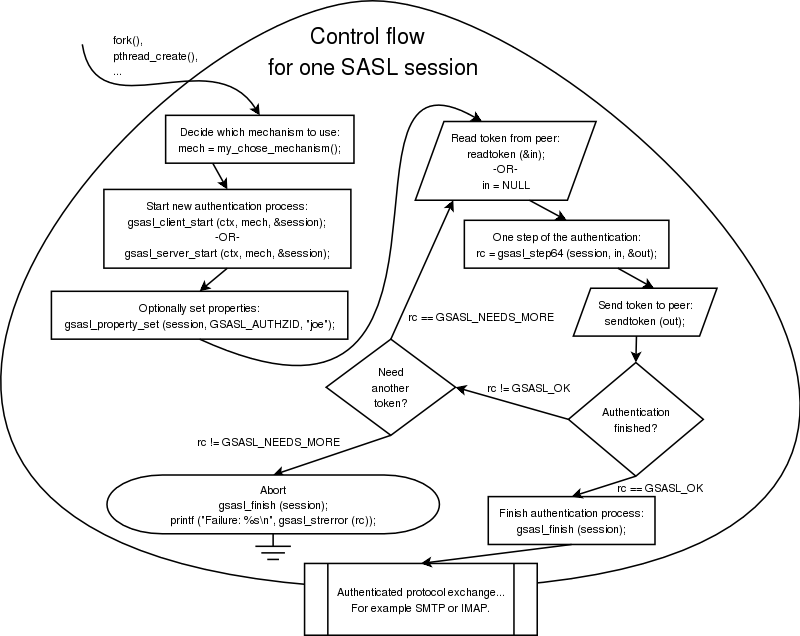
We will now show the implementation of the client function used
before.
void client (Gsasl *ctx)
{
  Gsasl_session *session;
  const char *mech = "PLAIN";
  int rc;

  /* Create new authentication session. */
  if ((rc = gsasl_client_start (ctx, mech, &session)) != GSASL_OK)
    {
      printf ("Cannot initialize client (%d): %s\n",
              rc, gsasl_strerror (rc));
      return;
    }

  /* Set username and password in session handle.  This info will be
     lost when this session is deallocated below.  */
  rc = gsasl_property_set (session, GSASL_AUTHID, "jas");
  if (rc != GSASL_OK)
    {
      printf ("Cannot set property (%d): %s\n", rc, gsasl_strerror (rc));
      return;
    }
  rc = gsasl_property_set (session, GSASL_PASSWORD, "secret");
  if (rc != GSASL_OK)
    {
      printf ("Cannot set property (%d): %s\n", rc, gsasl_strerror (rc));
      return;
    }

  /* Do it. */
  client_authenticate (session);

  /* Cleanup. */
  gsasl_finish (session);
}
This function is responsible for deciding which mechanism to use. In
this case, the ‘PLAIN’ mechanism is hard coded, but you will see
later how this can be made more flexible. The function creates a new
session, then it stores the username and password in the session
handle, then it calls another function client_authenticate to
handle the authentication loop, and finally it cleans up up. Let’s
continue with the implementation of client_authenticate.
void client_authenticate (Gsasl_session * session)
{
  char buf[BUFSIZ] = "";
  char *p;
  int rc;

  /* This loop mimics a protocol where the server sends data
     first. */

  do
    {
      printf ("Input base64 encoded data from server:\n");
      fgets (buf, sizeof (buf) - 1, stdin);
      if (buf[strlen (buf) - 1] == '\n')
        buf[strlen (buf) - 1] = '\0';

      rc = gsasl_step64 (session, buf, &p);

      if (rc == GSASL_NEEDS_MORE || rc == GSASL_OK)
        {
          printf ("Output:\n%s\n", p);
          free (p);
        }
    }
  while (rc == GSASL_NEEDS_MORE);

  printf ("\n");

  if (rc != GSASL_OK)
    {
      printf ("Authentication error (%d): %s\n",
              rc, gsasl_strerror (rc));
      return;
    }

  /* The client is done.  Here you would typically check if the
     server let the client in.  If not, you could try again. */

  printf ("If server accepted us, we're done.\n");
}
This last function needs to be discussed in some detail. First, you should be aware that there are two versions of this function, that differ in a subtle way. The version above (see Example 2) is used for application profiles where the server sends data first. For some mechanisms, this may waste a roundtrip, because the server needs input from the client to proceed. Therefor, today the recommended approach is to permit client to send data first (see Example 1). Which version you should use depends on which application protocol you are implementing.
Further, you should realize that it is bad programming style to use a
fixed size buffer. On GNU systems, you may use the getline
functions instead of fgets. However, in practice, there are
few mechanisms that use very large tokens. In typical configurations,
the mechanism with the largest tokens (GSSAPI) can use at least 500
bytes. A fixed buffer size of 8192 bytes may thus be sufficient for
now. But don’t say I didn’t warn you, when a future mechanism doesn’t
work in your application, because of a fixed size buffer.
The function gsasl_step64 (and of course also gasl_step)
returns two non-error return codes. GSASL_OK is used for
success, indicating that the library considers the authentication
finished. That may include a successful server authentication,
depending on the mechanism. You must not let the client continue to
the application protocol part unless you receive GSASL_OK from
these functions. In particular, don’t be fooled into believing
authentication were successful if the server replies “OK” but these
functions have failed with an error. The server may have been hacked,
and could be tricking you into sending confidential data, without
having successfully authenticated the server.
The non-error return code GSASL_NEEDS_MORE is used to signal to
your application that you should send the output token to the peer,
and wait for a new token, and do another iteration. If the server
concludes the authentication process, with no data, you should call
gsasl_step64 (or gsasl_step) specifying a zero-length
token.
If the functions (gsasl_step and gsasl_step64) return
any non-error code, the content of the output buffer is undefined.
Otherwise, it is the callers responsibility to deallocate the buffer,
by calling free. Note that in some situations, where the
buffer is empty, NULL is returned as the buffer value. You
should treat this as an empty buffer.
3.1 Choosing a mechanism
Our earlier code was hard coded to use a specific mechanism. This is
rarely a good idea. Instead, it is recommended to select the best
mechanism available from the list of mechanisms supported by the
server. Note that without TLS or similar, the list may have been
maliciously altered, by an attacker. This means that you should abort
if you cannot find any mechanism that exceeds your minimum security
level. There is a function gsasl_client_suggest_mechanism
(see Global Functions) that will try to pick the “best”
available mechanism from a list of mechanisms. Our simple interactive
example client (see Example 3) includes the following function to
decide which mechanism to use. Note that the code doesn’t blindly use
what is returned from gsasl_client_suggest_mechanism, rather it
lets some logic (in this case the user, through an interactive query)
decide which mechanism is acceptable.
const char *client_mechanism (Gsasl *ctx)
{
  static char mech[GSASL_MAX_MECHANISM_SIZE + 1] = "";
  char mechlist[BUFSIZ] = "";
  const char *suggestion;

  printf ("Enter list of server supported mechanisms, separate by SPC:\n");
  fgets (mechlist, sizeof (mechlist) - 1, stdin);

  suggestion = gsasl_client_suggest_mechanism (ctx, mechlist);
  if (suggestion)
    printf ("Library suggests use of `%s'.\n", suggestion);

  printf ("Enter mechanism to use:\n");
  fgets (mech, sizeof (mech) - 1, stdin);
  mech[strlen (mech) - 1] = '\0';

  return mech;
}
When running this example code, it might look like in the following output.
Enter list server supported mechanisms, separate by SPC:
CRAM-MD5 DIGEST-MD5 GSSAPI FOO BAR
Library suggests use of `GSSAPI'.
Enter mechanism to use:
CRAM-MD5
Input base64 encoded data from server:
Zm5vcmQ=
Output:
amFzIDkyY2U1NWE5MTM2ZTY4NzEyMTUyZTFjYmFmNjVkZjgx

If server accepted us, we're done.
3.2 Using a callback
Our earlier code specified the username and password before the authentication loop, as in:
gsasl_property_set (ctx, GSASL_AUTHID, "jas");
gsasl_property_set (ctx, GSASL_PASSWORD, "secret");
This may work for simple mechanisms, that need only a username and a password. But some mechanism requires more information, such as an authorization identity, a special PIN or passcode, a realm, a hostname, a service name, or an anonymous identifier. Querying the user for all that information, without knowing exactly which of it is really needed will result in a poor user interface. The user should not have to input private information, if it isn’t required.
The approach is a bad idea for another reason. What if the server aborts the authentication process? Then your application has already queried the user for a username and password. It would be better if you only asked the user for this information, annoying to input, when it is known to be needed.
A better approach to this problem is to use a callback. Then the mechanism may query your application whenever it needs some information, like the username and password. It will only do this at the precise step in the authentication when the information is actually needed. Further, if the user aborts, e.g., a password prompt, the mechanism is directly informed of this (because it invoked the callback), and could recover somehow.
Our final example (see Example 4) specifies a callback function,
inside main as below.
/* Set the callback handler for the library. */
gsasl_callback_set (ctx, callback);
The function itself is implemented as follows.
int callback (Gsasl * ctx, Gsasl_session * sctx, Gsasl_property prop)
{
  char buf[BUFSIZ] = "";
  int rc = GSASL_NO_CALLBACK;

  /* Get user info from user. */

  printf ("Callback invoked, for property %d.\n", prop);

  switch (prop)
    {
    case GSASL_PASSCODE:
      printf ("Enter passcode:\n");
      fgets (buf, sizeof (buf) - 1, stdin);
      buf[strlen (buf) - 1] = '\0';

      rc = gsasl_property_set (sctx, GSASL_PASSCODE, buf);
      break;

    case GSASL_AUTHID:
      printf ("Enter username:\n");
      fgets (buf, sizeof (buf) - 1, stdin);
      buf[strlen (buf) - 1] = '\0';

      rc = gsasl_property_set (sctx, GSASL_AUTHID, buf);
      break;

    default:
      printf ("Unknown property!  Don't worry.\n");
      break;
    }

  return rc;
}
Again, it is bad style to use a fixed size buffer. Mmm’kay.
Which properties you should handle is up to you. If you don’t know how
to respond to a certain property, simply return
GSASL_NO_CALLBACK. The basic properties to support are
authentication identity (GSASL_AUTHID), authorization identity
(GSASL_AUTHZID), and password (GSASL_PASSWORD).
See Properties, for the list of all properties, and what your callback
should (ideally) do for them, and which properties each mechanism
require in order to work.
Next: Mechanisms, Previous: Using the Library, Up: GNU Simple Authentication and Security Layer [Contents][Index]
4 Properties
The library uses a concept called “properties” to request and pass
data between the application and the individual authentication
mechanisms. The application can set property values using the
gsasl_property_set function. If a mechanism needs a property
value the application has not yet provided, this is handled through a
callback. The application provides a callback, using
gsasl_callback_set, which will be invoked with a property
parameter. The callback should set the property before returning, or
fail. See Callback Functions, for more information.
There are two kind of properties. The first, a “data property” is
the simplest to understand because it normally refers to short
strings. For example, the property called GSASL_AUTHID
correspond to the username string, e.g., simon.
The latter properties, called “logical properties”, are used by the
server to make a authentication decision, and is used as a way to get
the application callback invoked. For example, the property
GSASL_VALIDATE_SIMPLE is used by the server-side part of
mechanisms like PLAIN. The purpose is to ask the server
application to decide whether the user should be authenticated
successfully or not. The callback typically look at other property
fields, such as GSASL_AUTHID and GSASL_PASSWORD, and
compare those values with external information (for example data
stored in a database or on a LDAP server) and then return OK or not.
Warning: Don’t expect that all mechanisms invoke one of the “logical properties” in the server mode. For example, the CRAM-MD5 and SCRAM-SHA-1 mechanisms will use the data properties (i.e., username and password) provided by the application to internally decide whether to successfully authenticate the user. User authorization decisions needs to be made by the application outside of the SASL mechanism negotiation.
The logical properties are currently only used by servers, but data properties are used by both client and servers. It makes sense to think about the latter category as ‘server properties’ but the reverse is not valid nor useful.
The semantics associated with a data property is different when it is
used in client context and in the server context. For example, in the
client context, the application is expected to set the property
GSASL_AUTHID to signal to the mechanism the username to use,
but in the server context, the GSASL_AUTHID property is set by
the mechanism and can be used by the application (in the callback) to
find out what username the client provided.
Below is a list of all properties and an explanation for each. First is the list of data properties:
-
GSASL_AUTHIDThe authentication identity.
-
GSASL_AUTHZIDThe authorization identity.
-
GSASL_PASSWORDThe password of the authentication identity.
-
GSASL_ANONYMOUS_TOKENThe anonymous token. This is typically the email address of the user.
-
GSASL_SERVICEThe registered GSSAPI service name of the application service, e.g. “imap”. While the names are registered for GSSAPI, other mechanisms such as DIGEST-MD5 may also use this.
-
GSASL_HOSTNAMEShould be the local host name of the machine.
-
GSASL_GSSAPI_DISPLAY_NAMEContain the GSSAPI “display name”, set by the server GSSAPI mechanism. Typically you retrieve this property in your callback, when invoked for
GSASL_VALIDATE_GSSAPI. -
GSASL_REALMThe name of the authentication domain. This is used by several mechanisms, including DIGEST-MD5, GSS-API, and NTLM.
-
GSASL_PASSCODEThe SecurID passcode.
-
GSASL_PINThe SecurID personal identification number (PIN).
-
GSASL_SUGGESTED_PINA SecurID personal identification number (PIN) suggested by the server.
-
GSASL_DIGEST_MD5_HASHED_PASSWORDFor the DIGEST-MD5 mechanism, this is a hashed password. It is used in servers to avoid storing clear-text credentials.
-
GSASL_QOPSThe DIGEST-MD5 server query for this property to get the set of quality of protection (QOP) values to advertise. The property holds strings with comma separated keywords denoting the set of qops to use, for example
qop-auth, qop-int. Valid keywords areqop-auth,qop-int, andqop-conf. -
GSASL_QOPThe DIGEST-MD5 client query for this property to get the quality of protection (QOP) values to request. The property value is one of the keywords for
GSASL_QOPS. The client must chose one of the QOP values offered by the server (which may be inspected through theGSASL_QOPSproperty). -
GSASL_SCRAM_SALTED_PASSWORDIn a client, the SCRAM mechanism (see The SCRAM mechanisms) will request this property from the application. The value should be hex-encoded string (40 characters for SCRAM-SHA-1 and 64 characters for SCRAM-SHA-256) with the user’s PBKDF2-prepared password. Note that the value is different for the same password for each value of the
GSASL_SCRAM_ITERandGSASL_SCRAM_SALTproperties. The property can be used to avoid storing a clear-text credential in the client, however note that an attacker who steal it may impersonate both a SCRAM client and SCRAM server. If the property is not available, the mechanism will ask for theGSASL_PASSWORDproperty instead.The
GSASL_SCRAM_SALTED_PASSWORDproperty is set by the SCRAM mechanism if it derived the value from aGSASL_PASSWORDvalue supplied during authentication. Thus, the application may cache this value for future authentication attempts. -
GSASL_SCRAM_ITER -
GSASL_SCRAM_SALTIn the server, the application can set these properties to influence the hash iteration count and hash salt to use when deriving the password in the SCRAM mechanism (see The SCRAM mechanisms). The default hash iteration count is 4096 and often you should use a higher value. The salt should be a base64-encoded string with random data, typical length 4 to 16 bytes.
In the client, the SCRAM mechanism set these properties (using values received from the server) before asking the application to provide a
GSASL_SCRAM_SALTED_PASSWORDvalue.After the final authentication step, the properties are set by the mechanism, to allow the application to retrieve the values used (required when storing the
GSASL_SCRAM_SALTED_PASSWORDvalue, for example). -
GSASL_SCRAM_SERVERKEY -
GSASL_SCRAM_STOREDKEYThese properties are requested by the SCRAM server mechanism (see The SCRAM mechanisms), and if they are not available it will ask for
GSASL_PASSWORDorGSASL_SCRAM_SALTED_PASSWORDto complete authentication. The values are base64-encoded strings; 28 characters for SCRAM-SHA-1 and 44 characters for SCRAM-SHA-256. The properties are set after completing the final authentication step; so ifGSASL_PASSWORDorGSASL_SCRAM_SALTED_PASSWORDwas used for authentication, the application may extractGSASL_SCRAM_SERVERKEYandGSASL_SCRAM_STOREDKEYto use these values in a future authentication instead of the password. The values can be calculated usinggsasl_scram_secrets_from_password,gsasl_scram_secrets_from_salted_password(see Utilities) or using the--mkpasswdparameter for thegsaslutility (see Invoking gsasl). -
GSASL_CB_TLS_UNIQUEThis property holds base64 encoded
tls-uniquechannel binding data. As a hint, if you use GnuTLS, the APIgnutls_session_channel_bindingcan be used to extract channel bindings for a session. To be secure, a TLS channel MUST have the session hash extension (RFC 7627) negotiated, or session resumption MUST NOT have been used. The library cannot enforce this, so it is up to the application to only provide theGSASL_CB_TLS_UNIQUEproperty when the condition holds. Note that TLS version 1.3 and later do not support this channel binding. -
GSASL_CB_TLS_EXPORTERThis property holds base64 encoded
tls-exporterchannel binding data. As a hint, if you use GnuTLS, the APIgnutls_session_channel_bindingcan be used to extract channel bindings for a session. This fixes some of the security problems with thetls-uniquechannel binding and supports modern TLS versions. -
GSASL_SAML20_IDP_IDENTIFIERThis property holds the SAML identifier of the user. The SAML20 mechanism in client mode will send it to the other end for identification purposes, and in server mode it will be accessible in the
GSASL_SAML20_REDIRECT_URLcallback. -
GSASL_SAML20_REDIRECT_URLThis property holds the SAML redirect URL that the server wants the client to access. It will be available in theGSASL_SAML20_AUTHENTICATE_IN_BROWSERcallback for the client. -
GSASL_OPENID20_REDIRECT_URLThis property holds the SAML redirect URL that the server wants the client to access. It will be available in theGSASL_OPENID20_AUTHENTICATE_IN_BROWSERcallback for the client. -
GSASL_OPENID20_OUTCOME_DATAOpenID 2.0 authentication outcome data. This is either the OpenID SREG values or a value list starting with"openid.error="to signal error.
Next follows a list of data properties used to trigger the callback, typically used in servers to validate client credentials:
-
GSASL_VALIDATE_SIMPLEUsed by multiple mechanisms in server mode. The callback may retrieve the
GSASL_AUTHID,GSASL_AUTHZIDandGSASL_PASSWORDproperty values and use them to make an authentication and authorization decision. -
GSASL_VALIDATE_EXTERNALUsed by EXTERNAL mechanism on the server side to validate the client. The GSASL_AUTHID will contain the authorization identity of the client.
-
GSASL_VALIDATE_ANONYMOUSUsed by ANONYMOUS mechanism on the server side to validate the client. The GSASL_ANONYMOUS_TOKEN will contain token that identity the client.
-
GSASL_VALIDATE_GSSAPIUsed by the GSSAPI and GS2-KRB5 mechanisms on the server side, to validate the client. You may retrieve the authorization identity from GSASL_AUTHZID and the GSS-API display name from GSASL_GSSAPI_DISPLAY_NAME.
-
GSASL_VALIDATE_SECURIDUsed by SECURID mechanism on the server side to validate client. The GSASL_AUTHID, GSASL_AUTHZID, GSASL_PASSCODE, and GSASL_PIN will be set. It can return GSASL_SECURID_SERVER_NEED_ADDITIONAL_PASSCODE to ask the client to supply another passcode, and GSASL_SECURID_SERVER_NEED_NEW_PIN to require the client to supply a new PIN code.
-
GSASL_VALIDATE_SAML20Used by the SAML20 mechanism on the server side to request that the application perform authentication. The callback should return
GSASL_OKif the user should be permitted access, andGSASL_AUTHENTICATION_ERROR(or another error code) otherwise. -
GSASL_VALIDATE_OPENID20Used by the OPENID20 mechanism on the server side to request that the application perform authentication. The callback should return
GSASL_OKif the user should be permitted access, andGSASL_AUTHENTICATION_ERROR(or another error code) otherwise. -
GSASL_SAML20_AUTHENTICATE_IN_BROWSERUsed by the SAML20 mechanism in the client side to request that the client should launch the SAML redirect URL (theGSASL_SAML20_REDIRECT_URLproperty) in a browser to continue with authentication. -
GSASL_OPENID20_AUTHENTICATE_IN_BROWSERUsed by the OPENID20 mechanism in the client side to request that the client should launch the OpenID redirect URL (theGSASL_OPENID20_REDIRECT_URLproperty) in a browser to continue with authentication.
Next: Global Functions, Previous: Properties, Up: GNU Simple Authentication and Security Layer [Contents][Index]
5 Mechanisms
Different SASL mechanisms have different requirements on the application using it. To handle these differences the library can use a callback function into your application in several different ways. Some mechanisms, such as ‘PLAIN’, are simple to explain and use. The client callback queries the user for a username and password. The server callback hands the username and password into any local policy deciding authentication system (such as /etc/passwd via PAM).
Mechanism such as ‘CRAM-MD5’ and ‘SCRAM-SHA-256’ uses hashed passwords. The client callback behaviour is the same as for PLAIN. However, the server does not receive the plain text password over the network but rather a hash of it. Existing policy deciding systems like PAM cannot handle this, so the server callback for these mechanisms are more complicated.
Further, mechanisms like GSSAPI/GS2-KRB5 (Kerberos 5) assume a specific authentication system. In theory this means that the SASL library would not need to interact with the application, but rather call this specific authentication system directly. However, some callbacks are supported anyway, to modify the behaviour of how the specific authentication system is used (i.e., to handle “super-user” login as some other user).
Some mechanisms, like ‘EXTERNAL’ and ‘ANONYMOUS’ are entirely dependent on callbacks.
- The EXTERNAL mechanism
- The ANONYMOUS mechanism
- The PLAIN mechanism
- The LOGIN mechanism
- The CRAM-MD5 mechanism
- The DIGEST-MD5 mechanism
- The SCRAM mechanisms
- The NTLM mechanism
- The SECURID mechanism
- The GSSAPI mechanism
- The GS2-KRB5 mechanism
- The SAML20 mechanism
- The OPENID20 mechanism
Next: The ANONYMOUS mechanism, Up: Mechanisms [Contents][Index]
5.1 The EXTERNAL mechanism
The EXTERNAL mechanism is used to authenticate a user to a server based on out-of-band authentication. EXTERNAL is typically used over TLS authenticated channels. Note that in the server, you need to make sure that TLS actually authenticated the client successfully and that the negotiated ciphersuite and other parameters are acceptable. It is generally not sufficient that TLS is used, since TLS supports anonymous and other variants that generally provide less assurance than you normally want.
In the client, this mechanism is always enabled, and it will send the
GSASL_AUTHZID property as the authorization name to the server,
if the property is set. If the property is not set, an empty
authorization name is sent. You need not implement a callback.
In the server, this mechanism will request the
GSASL_VALIDATE_EXTERNAL callback property to decide whether the
client is authenticated and authorized to log in. Your callback can
retrieve the GSASL_AUTHZID property to inspect the requested
authorization name from the client.
The EXTERNAL mechanism was initially specified in the core SASL framework RFC 2222 and later revised in RFC 4422.
Next: The PLAIN mechanism, Previous: The EXTERNAL mechanism, Up: Mechanisms [Contents][Index]
5.2 The ANONYMOUS mechanism
The ANONYMOUS mechanism is used to “authenticate” clients to anonymous services; or rather, just indicate that the client wishes to use the service anonymously. The client sends a token, usually her email address, which serve the purpose of some trace information suitable for logging. The token cannot be empty.
In the client, this mechanism is always enabled, and will send the
GSASL_ANONYMOUS_TOKEN property as the trace information to the
server.
In the server, this mechanism will invoke the
GSASL_VALIDATE_ANONYMOUS callback to decide whether the client
should be permitted to log in. Your callback can retrieve the
GSASL_ANONYMOUS_TOKEN property to, for example, record it in a
log file. The token is normally not used to decide whether the client
should be permitted to log in or not.
The ANONYMOUS mechanism was initially specified in RFC 2245 and later revised in RFC 4505.
Next: The LOGIN mechanism, Previous: The ANONYMOUS mechanism, Up: Mechanisms [Contents][Index]
5.3 The PLAIN mechanism
The PLAIN mechanism uses username and password to authenticate users. Two user names are relevant. The first, the authentication identity, indicates the credential holder, i.e., whom the provided password belongs to. The second, the authorization identity, is typically empty to indicate that the user requests to log on to the server as herself (i.e., the authentication identity). If the authorization identity is not empty, the server should decide whether the authenticated user may log on as the authorization identity. This is typically used for super-user accounts like ‘admin’ to take on the role of a regular user.
In the client, this mechanism is always enabled, and require the
GSASL_AUTHID and GSASL_PASSWORD properties. If set,
GSASL_AUTHZID will also be used.
In the server, the mechanism is always enabled. Two approaches to authenticate and authorize the client are provided.
In the first approach, the server side of the mechanism will request
the GSASL_VALIDATE_SIMPLE callback property to decide whether
the client should be accepted or not. The callback may inspect the
GSASL_AUTHID, GSASL_AUTHZID, and GSASL_PASSWORD
properties. These property values will be normalized.
If the first approach fails (because there is no callback or your
callback returns ‘GSASL_NO_CALLBACK’ to signal that it does not
implement GSASL_VALIDATE_SIMPLE) the mechanism will continue to
query the application for a password, via the GSASL_PASSWORD
property. Your callback may use the GSASL_AUTHID and
GSASL_AUTHZID properties to select the proper password. The
password is then normalized and compared to the client credential.
Which approach to use? If your database stores hashed passwords, you have no option, but must use the first approach. If passwords in your user database are stored in prepared (SASLprep) form, the first approach will be faster. If you do not have prepared passwords available, you can use the second approach to make sure the password is prepared properly before comparison.
The PLAIN mechanism was initially specified in RFC 2595 and later revised in RFC 4616.
Next: The CRAM-MD5 mechanism, Previous: The PLAIN mechanism, Up: Mechanisms [Contents][Index]
5.4 The LOGIN mechanism
The LOGIN mechanism is a non-standard mechanism, and is similar to the PLAIN mechanism except that LOGIN lacks the support for authorization identities. Always use PLAIN instead of LOGIN in new applications.
The callback behaviour is the same as for PLAIN, except that
GSASL_AUTHZID is neither used nor required, and that the server
does not normalize the password using SASLprep.
See Use of SASLprep in LOGIN, for a proposed clarification of the interpretation of a hypothetical LOGIN specification.
Next: The DIGEST-MD5 mechanism, Previous: The LOGIN mechanism, Up: Mechanisms [Contents][Index]
5.5 The CRAM-MD5 mechanism
CRAM-MD5 is a widely used challenge-response mechanism that transfers hashed passwords instead of clear text passwords. It is official deprecated, initially in favor of first DIGEST-MD5 but today SCRAM-SHA-1. For insecure channels (e.g., when TLS is not used), it is has better properties than PLAIN since the unhashed password is not leaked. The CRAM-MD5 mechanism does not support authorization identities; that make the relationship between CRAM-MD5 and DIGEST-MD5/SCRAM-SHA-* similar to the relationship between LOGIN and PLAIN.
The disadvantage with hashed passwords is that the server cannot use normal authentication infrastructures such as PAM, because the server must have access to the unhashed password in order to validate every authentication attempt.
In the client, this mechanism is always enabled, and it requires the
GSASL_AUTHID and GSASL_PASSWORD properties.
In the server, the mechanism will require the GSASL_PASSWORD
callback property, which may use the GSASL_AUTHID property to
determine which users’ password should be used. The GSASL_AUTHID
will be in normalized form. The server will then normalize the
password, and compare the client response with the computed correct
response, and accept the user accordingly.
See Use of SASLprep in CRAM-MD5, for a clarification on the interpretation of the CRAM-MD5 specification that this implementation rely on.
The CRAM-MD5 mechanism was initially specified in RFC 2095 but quickly revised in RFC 2195. Note that both were published before the core SASL framework, which explains its lack of authorization identity.
Next: The SCRAM mechanisms, Previous: The CRAM-MD5 mechanism, Up: Mechanisms [Contents][Index]
5.6 The DIGEST-MD5 mechanism
The DIGEST-MD5 mechanism is based on repeated hashing using MD5. After the MD5 break may be argued to be weaker than HMAC-MD5 that CRAM-MD5 builds on, but DIGEST-MD5 supports other features. For example, authorization identities and data integrity and privacy protection are supported. Like CRAM-MD5, only a hashed password is transferred. Consequently, DIGEST-MD5 needs access to the correct password to verify the client response – however the server can store the password in hashed form, another improvement compared to CRAM-MD5 . Alas, this makes it impossible to use, e.g., PAM on the server side.
In the client, this mechanism is always enabled, and it requires the
GSASL_AUTHID, GSASL_PASSWORD, GSASL_SERVICE, and
GSASL_HOSTNAME properties. If set, GSASL_AUTHZID and
GSASL_REALM will also be used.
In the server, the mechanism will first request the
GSASL_DIGEST_MD5_HASHED_PASSWORD callback property to get the
user’s hashed password. If the callback doesn’t supply a hashed
password (i.e., it returns ‘GSASL_NO_CALLBACK’), the
GSASL_PASSWORD callback property will be requested. Both
callbacks may use the GSASL_AUTHID, GSASL_AUTHZID and
GSASL_REALM properties to determine which users’ password should
be used. The server will then compare the client response with a
computed correct response, and accept the user accordingly.
The server uses the GSASL_QOPS callback to get the set of
quality of protection values to use. By default, it advertises
support for authentication (qop-auth) only. You can use the
callback, for example, to make the server advertise support for
authentication with integrity layers.
The client uses the GSASL_QOP callback to get the quality of
protection value to request. The client must choose one of the QOP
values offered by the server (which may be inspected through the
GSASL_QOPS property). If the client does not return a value,
qop-auth is used by default.
The security layers of DIGEST-MD5 are rarely used in practice due to interoperability and security reasons. You are recommended to use TLS instead.
The DIGEST-MD5 mechanism is specified in RFC 2831. RFC 6331 labels DIGEST-MD5 as historic and it contains a good exposition of the disadvantages with DIGEST-MD5.
Next: The NTLM mechanism, Previous: The DIGEST-MD5 mechanism, Up: Mechanisms [Contents][Index]
5.7 The SCRAM mechanisms
SCRAM is a family of mechanisms and we support SCRAM-SHA-1 and SCRAM-SHA-256. They differ only in the use of underlying hash function, SHA-1 and SHA-256 respectively. Channel bindings are supported through the SCRAM-SHA-1-PLUS and SCRAM-SHA-256-PLUS mechanisms, and will bind the authentication to a particular TLS channel. SCRAM provides mutual authentication, i.e., after a succesful authentication the client will know that the server knows the password, and the server will know that the client knows the password. Further, this can be achieved without storing the password in clear text on either side.
The SCRAM family is designed to provide the same capabilities that CRAM-MD5 and DIGEST-MD5 provides but with modern cryptographic techniques such as HMAC hashing and PKCS#5 PBKDF2 key derivation. SCRAM supports authorization identities. Like CRAM-MD5 and DIGEST-MD5, only a hashed password is transferred. Consequently, SCRAM servers needs access to the correct password, the salted password, or the derived ServerKey/StoredKey values, to verify the client response.
In the client, the non-PLUS mechanism is always enabled, and it requires
the GSASL_AUTHID property, and either GSASL_PASSWORD or
GSASL_SCRAM_SALTED_PASSWORD. When the GSASL_CB_TLS_UNIQUE
property is available, the SCRAM-SHA-1-PLUS mechanism is also available
and it will negotiate channel bindings when the server also supports it.
If set, GSASL_AUTHZID will be used by the client. To be able to
return the proper GSASL_SCRAM_SALTED_PASSWORD value, the callback
needs to check the GSASL_SCRAM_ITER and GSASL_SCRAM_SALT
values which are available when the GSASL_SCRAM_SALTED_PASSWORD
property is queried for. The client/server may retrieve the calculated
GSASL_SCRAM_SALTED_PASSWORD value by retrieving it after the
final authentication step. The GSASL_SCRAM_SALTED_PASSWORD value
can also be derived by using the
gsasl_scram_secrets_from_password function (see Utilities),
or through the --mkpasswd parameter for the gsasl utility
(see Invoking gsasl).
In the server, the GSASL_AUTHID property (and, when provided by
the client, the GSASL_AUTHZID property) will be set in order for
the callback to retrieve the user credentials. The server mechanism
will request the GSASL_SERVERKEY and GSASL_STOREDKEY
properties first, and will use them to complete authentication. Using
ServerKey/StoredKey on the server make it possible for the server to
avoid storing the clear-text password. If ServerKey/StoredKey is not
available, the GSASL_SCRAM_SALTED_PASSWORD property is request,
and used to derive the ServetKey/StoredKey secrets. When
GSASL_SCRAM_SALTED_PASSWORD is not available, the
GSASL_PASSWORD property is requested, which will be used to
derive the ServetKey/StoredKey secrets. The mechanism uses the
credentials to authenticate the user. The application may set the
GSASL_SCRAM_ITER and GSASL_SCRAM_SALT properties which
allow the server to tell the clients what values to use for deriving a
key from a password. When the application do not supply them, the SCRAM
server will default to using a fresh random salt and an iteration count
of 4096. After the final authentication step, the application may
retrieve the GSASL_SCRAM_ITER, GSASL_SCRAM_SALT,
GSASL_SCRAM_SALTED_PASSWORD, GSASL_SERVERKEY, and
GSASL_STOREDKEY properties for potential storage in a database to
avoid the need to store the cleartext password. When the
GSASL_CB_TLS_UNIQUE property is set, the SCRAM-*-PLUS mechanism
is supported and is used to negotiate channel bindings.
It is recommended for servers to stored ServerKey/StoredKey in a
database instead of GSASL_SCRAM_SALTED_PASSWORD, when possible,
since the latter is a password-equivalent but the former cannot directly
be used to impersonate the client (although one failed authentication
exchange against the server is sufficient to recover a
plaintext-equivalent from ServerKey/StoredKey).
The GSASL_CB_TLS_UNIQUE property signal that this side of the
authentication supports channel bindings. Setting the property will
enable the SCRAM-SHA-1-PLUS and SCRAM-SHA-256-PLUS mechanisms. For
clients, this also instructs the SCRAM-SHA-1 and SCRAM-SHA-256 mechanism
to tell servers that the client believes the server does not support
channel bindings if it is used (remember that clients should otherwise
have chosen the SCRAM-SHA-1-PLUS mechanism instead of the SCRAM-SHA-1
mechanism). For servers, it means the SCRAM-SHA-1/SCRAM-SHA-256
mechanism will refuse to authenticate against a client that signals that
it believes the server does not support channel bindings.
The SCRAM-SHA-*-PLUS mechanisms will never complete authentication successfully if channel bindings are not confirmed.
To offer the intended security, the SCRAM-SHA-*-PLUS mechanisms MUST be
used over a TLS channel that has had the session hash extension (RFC
7627) negotiated, or session resumption MUST NOT have been used. The
library cannot enforce this, so it is up to the application to only
provide the GSASL_CB_TLS_UNIQUE property when this condition
holds.
The SCRAM-SHA-1 mechanism is specified in RFC 5802 and SCRAM-SHA-256 is specified in RFC 7677. How to store SCRAM credentials in LDAP on the server side is described in RFC 5803.
Next: The SECURID mechanism, Previous: The SCRAM mechanisms, Up: Mechanisms [Contents][Index]
5.8 The NTLM mechanism
The NTLM is a non-standard mechanism. Do not use it in new applications, and do not expect it to be secure. Currently only the client side is supported.
In the client, this mechanism is always enabled, and it requires the
GSASL_AUTHID and GSASL_PASSWORD properties. It will set
the ‘domain’ field in the NTLM request to the value of
GSASL_REALM. Some servers reportedly need non-empty but
arbitrary values in that field.
Next: The GSSAPI mechanism, Previous: The NTLM mechanism, Up: Mechanisms [Contents][Index]
5.9 The SECURID mechanism
The SECURID mechanism uses authentication and authorization identity together with a passcode from a hardware token to authenticate users.
In the client, this mechanism is always enabled, and it requires the
GSASL_AUTHID and GSASL_PASSCODE properties. If set,
GSASL_AUTHZID will also be used. If the server requests it,
the GSASL_PIN property is also required, and its callback may
inspect the GSASL_SUGGESTED_PIN property to discover a
server-provided PIN to use.
In the server, this mechanism will invoke the
GSASL_VALIDATE_SECURID callback. The callback may inspect the
GSASL_AUTHID, GSASL_AUTHZID, and GSASL_PASSCODE
properties. The callback can return
GSASL_SECURID_SERVER_NEED_ADDITIONAL_PASSCODE to ask for
another additional passcode from the client. The callback can return
GSASL_SECURID_SERVER_NEED_NEW_PIN to ask for a new PIN code
from the client, in which case it may also set the
GSASL_SUGGESTED_PIN property to indicate a recommended new PIN.
If the callbacks is invoked again, after having returned
GSASL_SECURID_SERVER_NEED_NEW_PIN, it may also inspect the
GSASL_PIN property, in addition to the other properties, to
find out the client selected PIN code.
The SECURID mechanism is specified in RFC 2808.
Next: The GS2-KRB5 mechanism, Previous: The SECURID mechanism, Up: Mechanisms [Contents][Index]
5.10 The GSSAPI mechanism
The GSSAPI mechanism allows you to authenticate using Kerberos V5. The mechanism was originally designed to allow for any GSS-API mechanism to be used, but problems with the protocol made it unpractical and it is today restricted for use with Kerberos V5. See the GS2 mechanism (see The GS2-KRB5 mechanism) for a general solution. However, GSSAPI continues to be widely used in Kerberos V5 environments.
In the client, the mechanism is enabled only if the user has acquired
credentials (i.e., a ticket granting ticket), and it requires the
GSASL_AUTHZID, GSASL_SERVICE, and GSASL_HOSTNAME
properties. (Earlier versions of the library incorrectly probed for
GSASL_AUTHID and used it as the authorization identity.)
In the server, the mechanism requires the GSASL_SERVICE and
GSASL_HOSTNAME properties, and it will invoke the
GSASL_VALIDATE_GSSAPI callback property in order to validate the
user. The callback may inspect the GSASL_AUTHZID and
GSASL_GSSAPI_DISPLAY_NAME properties to decide whether to
authorize the user. Note that authentication is performed by the
GSS-API library and that GSASL_AUTHID is not used by the server
mechanism, its role is played by GSASL_GSSAPI_DISPLAY_NAME.
The protocol does not distinguish between an absent authorization identity and the empty authorization identity. Earlier versions of the library returned the empty string but currently it returns NULL, it is suggested to treat both the same for this mechanism.
The server-part does not support security layers. You are recommended to use TLS instead.
The GSSAPI mechanism was specified as part of the initial core SASL framework, in RFC 2222, but later revised in RFC 4752 to only apply to Kerberos V5.
Next: The SAML20 mechanism, Previous: The GSSAPI mechanism, Up: Mechanisms [Contents][Index]
5.11 The GS2-KRB5 mechanism
GS2 is a protocol bridge between GSS-API and SASL, and allows every GSS-API mechanism that supports mutual authentication and channel bindings to be used as a SASL mechanism. Currently GS2-KRB5 is supported, for Kerberos V5 authentication, however our GS2 implementation is flexible enough to easily support other GSS-API mechanism if any gains popularity.
In the client, the mechanism is enabled only if the user has acquired
credentials (i.e., a ticket granting ticket), and it requires the
GSASL_AUTHZID, GSASL_SERVICE, and GSASL_HOSTNAME
properties.
In the server, the mechanism requires the GSASL_SERVICE and
GSASL_HOSTNAME properties, and it will invoke the
GSASL_VALIDATE_GSSAPI callback property in order to validate the
user. The callback may inspect the GSASL_AUTHZID and
GSASL_GSSAPI_DISPLAY_NAME properties to decide whether to
authorize the user. Note that authentication is performed by the
GSS-API library and that GSASL_AUTHID is not used by the server
mechanism, its role is played by GSASL_GSSAPI_DISPLAY_NAME.
The GS2 framework supports a variant of each mechanism, called the PLUS variant, which can also bind the authentication to a secure channel through channel bindings. Currently this is not supported by GNU SASL.
The GS2 mechanism family was specified in RFC 5801.
Next: The OPENID20 mechanism, Previous: The GS2-KRB5 mechanism, Up: Mechanisms [Contents][Index]
5.12 The SAML20 mechanism
The SAML20 mechanism makes it possible to use SAML in SASL, in a way that offloads the authentication exchange to an external web browser.
The mechanism makes use of the following properties:
GSASL_AUTHZID, GSASL_SAML20_IDP_IDENTIFIER,
GSASL_SAML20_REDIRECT_URL,
GSASL_SAML20_AUTHENTICATE_IN_BROWSER and
GSASL_VALIDATE_SAML20.
In client mode, the mechanism will retrieve the GSASL_AUTHZID and
GSASL_SAML20_IDP_IDENTIFIER properties and form a request to the
server. The server will respond with a redirect URL stored in the
GSASL_SAML20_REDIRECT_URL property, which the client can retrieve
from the GSASL_SAML20_AUTHENTICATE_IN_BROWSER callback. The
intention is that the client launches a browser to the given URL, and
then proceeds with authentication. The server responds whether
authentication was successful or not.
In server mode, the mechanism will invoke the
GSASL_SAML20_REDIRECT_URL callback and the application can
inspect the GSASL_AUTHZID and GSASL_SAML20_IDP_IDENTIFIER
properties when forming the redirect URL. The URL is passed to the
client which will hopefully complete authentication in the browser. The
server callback GSASL_VALIDATE_SAML20 should check whether the
authentication attempt was successful.
Note that SAML itself is not implemented by the GNU SASL library. On
the client side, no SAML knowledge is needed, it is only required on the
server side. The client only needs to be able to start a web browser to
access the redirect URL. The server side is expected to call a SAML
library to generate the AuthRequest and to implement an
AssertionConsumerService (ACS) to validate the AuthResponse. There is a
complete proof-of-concept example of a SMTP server with SAML 2.0 support
distributed with GNU SASL in the examples/saml20/ sub-directory.
The example uses the Lasso SAML implementation
(http://lasso.entrouvert.org/) and require a web server for the
ACS side. The example may be used as inspiration for your own server
implementation. The gsasl command line client supports SAML20 as
a client.
The SAML20 mechanism is specified in RFC 6595.
Previous: The SAML20 mechanism, Up: Mechanisms [Contents][Index]
5.13 The OPENID20 mechanism
The OPENID20 mechanism makes it possible to use OpenID in SASL, in a way that offloads the authentication exchange to an external web browser.
The mechanism makes use of the following properties: GSASL_AUTHID
(for the OpenID User-Supplied Identifier), GSASL_AUTHZID,
GSASL_OPENID20_REDIRECT_URL, GSASL_OPENID20_OUTCOME_DATA,
GSASL_OPENID20_AUTHENTICATE_IN_BROWSER, and
GSASL_VALIDATE_OPENID20.
In the client, the mechanism is enabled by default. The
GSASL_AUTHID property is required and should contain the
User-Supplied OpenID Identifier (for example
https://josefsson.org). If set, GSASL_AUTHZID will be used
by the client. The client will be invoked with the
GSASL_OPENID20_AUTHENTICATE_IN_BROWSER callback to perform the
OpenID authentication in a web browser. The callback can retrieve the
GSASL_OPENID20_REDIRECT_URL property to find out the URL to
redirect the user to. After authentication, the client can retrieve the
GSASL_OPENID20_OUTCOME_DATA property with the OpenID Simple
Registry (SREG) attributes sent by the server (if any).
In the server, the mechanism is enabled by default. The server will
request the GSASL_OPENID20_REDIRECT_URL property, and your
callback may inspect the GSASL_AUTHID to find the OpenID
User-Supplied Identifier. The server callback should perform OpenID
discovery and return the URL to redirect the user to. After this, the
user would access the URL and proceed with authentication in the
browser. The server is invoked with the
GSASL_VALIDATE_OPENID20 callback to perform the actual
validation of the authentication. Usually the callback will perform
some IPC communication with an OpenID consumer running in a web
server. The callback should return GSASL_OK on successful
authentication and GSASL_AUTHENTICATION_ERROR on authentication
errors, or any other error code. If the server received some OpenID
Simple Registry (SREG) attributes from the OpenID Identity Provider,
it may use the GSASL_OPENID20_OUTCOME_DATA property to send
these to the client.
Note that OpenID itself is not implemented by the GNU SASL library. On
the client side, no OpenID knowledge is required, it is only required on
the server side. The client only needs to be able to start a web
browser to access the redirect URL. The server side is expected to use
an OpenID library to generate the redirect URL and to implement the
Service Provider (SP) to validate the response from the IdP. There is a
complete proof-of-concept example with a SMTP server with OpenID 2.0
support distributed with GNU SASL in the examples/openid20/
sub-directory. It uses the JanRain PHP5 OpenID implementation and
require a web server to implement the OpenID SP. The example may be
used as inspiration for your own server implementation. The
gsasl command line client supports OPENID20 as a client.
The OPENID20 mechanism is specified in RFC 6616.
Next: Callback Functions, Previous: Mechanisms, Up: GNU Simple Authentication and Security Layer [Contents][Index]
6 Global Functions
gsasl_init
- Function: int gsasl_init (Gsasl ** ctx) 
ctx: pointer to libgsasl handle.
This functions initializes libgsasl. The handle pointed to by ctx is valid for use with other libgsasl functions iff this function is successful. It also register all builtin SASL mechanisms, using
gsasl_register().Return value: GSASL_OK iff successful, otherwise
GSASL_MALLOC_ERROR.
gsasl_done
- Function: void gsasl_done (Gsasl * ctx) 
ctx: libgsasl handle.
This function destroys a libgsasl handle. The handle must not be used with other libgsasl functions after this call.
gsasl_client_mechlist
- Function: int gsasl_client_mechlist (Gsasl * ctx, char ** out) 
ctx: libgsasl handle.
out: newly allocated output character array.
Return a newly allocated string containing SASL names, separated by space, of mechanisms supported by the libgsasl client.
outis allocated by this function, and it is the responsibility of caller to deallocate it.Return value: Returns
GSASL_OKif successful, or error code.
gsasl_server_mechlist
- Function: int gsasl_server_mechlist (Gsasl * ctx, char ** out) 
ctx: libgsasl handle.
out: newly allocated output character array.
Return a newly allocated string containing SASL names, separated by space, of mechanisms supported by the libgsasl server.
outis allocated by this function, and it is the responsibility of caller to deallocate it.Return value: Returns
GSASL_OKif successful, or error code.
gsasl_client_support_p
- Function: int gsasl_client_support_p (Gsasl * ctx, const char * name) 
ctx: libgsasl handle.
name: name of SASL mechanism.
Decide whether there is client-side support for a specified mechanism.
Return value: Returns 1 if the libgsasl client supports the named mechanism, otherwise 0.
gsasl_server_support_p
- Function: int gsasl_server_support_p (Gsasl * ctx, const char * name) 
ctx: libgsasl handle.
name: name of SASL mechanism.
Decide whether there is server-side support for a specified mechanism.
Return value: Returns 1 if the libgsasl server supports the named mechanism, otherwise 0.
gsasl_client_suggest_mechanism
- Function: const char * gsasl_client_suggest_mechanism (Gsasl * ctx, const char * mechlist) 
ctx: libgsasl handle.
mechlist: input character array with SASL mechanism names, separated by invalid characters (e.g. SPC).
Given a list of mechanisms, suggest which to use.
Return value: Returns name of "best" SASL mechanism supported by the libgsasl client which is present in the input string, or NULL if no supported mechanism is found.
gsasl_register
- Function: int gsasl_register (Gsasl * ctx, const Gsasl_mechanism * mech) 
ctx: pointer to libgsasl handle.
mech: plugin structure with information about plugin.
This function initialize given mechanism, and if successful, add it to the list of plugins that is used by the library.
Return value:
GSASL_OKiff successful, otherwiseGSASL_MALLOC_ERROR.Since: 0.2.0
gsasl_mechanism_name_p
- Function: int gsasl_mechanism_name_p (const char * mech) 
mech: input variable with mechanism name string.
Check if the mechanism name string
mechfollows syntactical rules. It does not check that the name is registered with IANA. It does not check that the mechanism name is actually implemented and supported.SASL mechanisms are named by strings, from 1 to 20 characters in length, consisting of upper-case letters, digits, hyphens, and/or underscores.
Returns: non-zero when mechanism name string
mechconforms to rules, zero when it does not meet the requirements.Since: 2.0.0
Next: Property Functions, Previous: Global Functions, Up: GNU Simple Authentication and Security Layer [Contents][Index]
7 Callback Functions
The callback is used by mechanisms to retrieve information, such as
username and password, from the application. In a server, the
callback is used to decide whether a user is permitted to log in or
not. You tell the library of your callback function by calling
gsasl_callback_set.
Since your callback may need access to data from other parts of your
application, there are hooks to store and retrieve application
specific pointers. This avoids the use of global variables, which
wouldn’t be thread safe. You store a pointer to some information
(opaque from the point of view of the library) by calling
gsasl_callback_hook_set and can later retrieve this data in
your callback by calling gsasl_callback_hook_get.
gsasl_callback_set
- Function: void gsasl_callback_set (Gsasl * ctx, Gsasl_callback_function cb) 
ctx: handle received from
gsasl_init().cb: pointer to function implemented by application.
Store the pointer to the application provided callback in the library handle. The callback will be used, via
gsasl_callback(), by mechanisms to discover various parameters (such as username and passwords). The callback function will be called with a Gsasl_property value indicating the requested behaviour. For example, forGSASL_ANONYMOUS_TOKEN, the function is expected to invoke gsasl_property_set(CTX,GSASL_ANONYMOUS_TOKEN, "token") where "token" is the anonymous token the application wishes the SASL mechanism to use. See the manual for the meaning of all parameters.Since: 0.2.0
gsasl_callback
- Function: int gsasl_callback (Gsasl * ctx, Gsasl_session * sctx, Gsasl_property prop) 
ctx: handle received from
gsasl_init(), may be NULL to derive it fromsctx.sctx: session handle.
prop: enumerated value of Gsasl_property type.
Invoke the application callback. The
propvalue indicate what the callback is expected to do. For example, forGSASL_ANONYMOUS_TOKEN, the function is expected to invoke gsasl_property_set(SCTX,GSASL_ANONYMOUS_TOKEN, "token") where "token" is the anonymous token the application wishes the SASL mechanism to use. See the manual for the meaning of all parameters.Return value: Returns whatever the application callback returns, or
GSASL_NO_CALLBACKif no application was known.Since: 0.2.0
gsasl_callback_hook_set
- Function: void gsasl_callback_hook_set (Gsasl * ctx, void * hook) 
ctx: libgsasl handle.
hook: opaque pointer to application specific data.
Store application specific data in the libgsasl handle.
The application data can be later (for instance, inside a callback) be retrieved by calling
gsasl_callback_hook_get(). This is normally used by the application to maintain a global state between the main program and callbacks.Since: 0.2.0
gsasl_callback_hook_get
- Function: void * gsasl_callback_hook_get (Gsasl * ctx) 
ctx: libgsasl handle.
Retrieve application specific data from libgsasl handle.
The application data is set using
gsasl_callback_hook_set(). This is normally used by the application to maintain a global state between the main program and callbacks.Return value: Returns the application specific data, or NULL.
Since: 0.2.0
gsasl_session_hook_set
- Function: void gsasl_session_hook_set (Gsasl_session * sctx, void * hook) 
sctx: libgsasl session handle.
hook: opaque pointer to application specific data.
Store application specific data in the libgsasl session handle.
The application data can be later (for instance, inside a callback) be retrieved by calling
gsasl_session_hook_get(). This is normally used by the application to maintain a per-session state between the main program and callbacks.Since: 0.2.14
gsasl_session_hook_get
- Function: void * gsasl_session_hook_get (Gsasl_session * sctx) 
sctx: libgsasl session handle.
Retrieve application specific data from libgsasl session handle.
The application data is set using
gsasl_callback_hook_set(). This is normally used by the application to maintain a per-session state between the main program and callbacks.Return value: Returns the application specific data, or NULL.
Since: 0.2.14
Next: Session Functions, Previous: Callback Functions, Up: GNU Simple Authentication and Security Layer [Contents][Index]
8 Property Functions
gsasl_property_free
- Function: void gsasl_property_free (Gsasl_session * sctx, Gsasl_property prop) 
sctx: session handle.
prop: enumerated value of
Gsasl_propertytype to clearDeallocate associated data with property
propin session handle. After this call, gsasl_property_fast(sctx,prop) will always return NULL.Since: 2.0.0
gsasl_property_set
- Function: int gsasl_property_set (Gsasl_session * sctx, Gsasl_property prop, const char * data) 
sctx: session handle.
prop: enumerated value of Gsasl_property type, indicating the type of data in
data.data: zero terminated character string to store.
Make a copy of
dataand store it in the session handle for the indicated propertyprop.You can immediately deallocate
dataafter calling this function, without affecting the data stored in the session handle.Return value:
GSASL_OKiff successful, otherwiseGSASL_MALLOC_ERROR.Since: 0.2.0
gsasl_property_set_raw
- Function: int gsasl_property_set_raw (Gsasl_session * sctx, Gsasl_property prop, const char * data, size_t len) 
sctx: session handle.
prop: enumerated value of Gsasl_property type, indicating the type of data in
data.data: character string to store.
len: length of character string to store.
Make a copy of
lensizeddataand store a zero terminated version of it in the session handle for the indicated propertyprop.You can immediately deallocate
dataafter calling this function, without affecting the data stored in the session handle.Except for the length indicator, this function is identical to gsasl_property_set.
Return value:
GSASL_OKiff successful, otherwiseGSASL_MALLOC_ERROR.Since: 0.2.0
gsasl_property_fast
- Function: const char * gsasl_property_fast (Gsasl_session * sctx, Gsasl_property prop) 
sctx: session handle.
prop: enumerated value of Gsasl_property type, indicating the type of data in
data.Retrieve the data stored in the session handle for given property
prop.The pointer is to live data, and must not be deallocated or modified in any way.
This function will not invoke the application callback.
Return value: Return property value, if known, or NULL if no value known.
Since: 0.2.0
gsasl_property_get
- Function: const char * gsasl_property_get (Gsasl_session * sctx, Gsasl_property prop) 
sctx: session handle.
prop: enumerated value of Gsasl_property type, indicating the type of data in
data.Retrieve the data stored in the session handle for given property
prop, possibly invoking the application callback to get the value.The pointer is to live data, and must not be deallocated or modified in any way.
This function will invoke the application callback, using
gsasl_callback(), when a property value is not known.Return value: Return data for property, or NULL if no value known.
Since: 0.2.0
Next: Utilities, Previous: Property Functions, Up: GNU Simple Authentication and Security Layer [Contents][Index]
9 Session Functions
gsasl_client_start
- Function: int gsasl_client_start (Gsasl * ctx, const char * mech, Gsasl_session ** sctx) 
ctx: libgsasl handle.
mech: name of SASL mechanism.
sctx: pointer to client handle.
This functions initiates a client SASL authentication. This function must be called before any other gsasl_client_*() function is called.
Return value: Returns
GSASL_OKif successful, or error code.
gsasl_server_start
- Function: int gsasl_server_start (Gsasl * ctx, const char * mech, Gsasl_session ** sctx) 
ctx: libgsasl handle.
mech: name of SASL mechanism.
sctx: pointer to server handle.
This functions initiates a server SASL authentication. This function must be called before any other gsasl_server_*() function is called.
Return value: Returns
GSASL_OKif successful, or error code.
gsasl_step
- Function: int gsasl_step (Gsasl_session * sctx, const char * input, size_t input_len, char ** output, size_t * output_len) 
sctx: libgsasl session handle.
input: input byte array.
input_len: size of input byte array.
output: newly allocated output byte array.
output_len: pointer to output variable with size of output byte array.
Perform one step of SASL authentication. This reads data from the other end (from
inputandinput_len), processes it (potentially invoking callbacks to the application), and writes data to server (into newly allocated variableoutputandoutput_lenthat indicate the length ofoutput).The contents of the
outputbuffer is unspecified if this functions returns anything other thanGSASL_OKorGSASL_NEEDS_MORE. If this function returnGSASL_OKorGSASL_NEEDS_MORE, however, theoutputbuffer is allocated by this function, and it is the responsibility of caller to deallocate it by calling gsasl_free(output).Return value: Returns
GSASL_OKif authenticated terminated successfully,GSASL_NEEDS_MOREif more data is needed, or error code.
gsasl_step64
- Function: int gsasl_step64 (Gsasl_session * sctx, const char * b64input, char ** b64output) 
sctx: libgsasl client handle.
b64input: input base64 encoded byte array.
b64output: newly allocated output base64 encoded byte array.
This is a simple wrapper around
gsasl_step()that base64 decodes the input and base64 encodes the output.The contents of the
b64outputbuffer is unspecified if this functions returns anything other thanGSASL_OKorGSASL_NEEDS_MORE. If this function returnGSASL_OKorGSASL_NEEDS_MORE, however, theb64outputbuffer is allocated by this function, and it is the responsibility of caller to deallocate it by calling gsasl_free(b64output).Return value: Returns
GSASL_OKif authenticated terminated successfully,GSASL_NEEDS_MOREif more data is needed, or error code.
gsasl_finish
- Function: void gsasl_finish (Gsasl_session * sctx) 
sctx: libgsasl session handle.
Destroy a libgsasl client or server handle. The handle must not be used with other libgsasl functions after this call.
gsasl_encode
- Function: int gsasl_encode (Gsasl_session * sctx, const char * input, size_t input_len, char ** output, size_t * output_len) 
sctx: libgsasl session handle.
input: input byte array.
input_len: size of input byte array.
output: newly allocated output byte array.
output_len: pointer to output variable with size of output byte array.
Encode data according to negotiated SASL mechanism. This might mean that data is integrity or privacy protected.
The
outputbuffer is allocated by this function, and it is the responsibility of caller to deallocate it by calling gsasl_free(output).Return value: Returns
GSASL_OKif encoding was successful, otherwise an error code.
gsasl_decode
- Function: int gsasl_decode (Gsasl_session * sctx, const char * input, size_t input_len, char ** output, size_t * output_len) 
sctx: libgsasl session handle.
input: input byte array.
input_len: size of input byte array.
output: newly allocated output byte array.
output_len: pointer to output variable with size of output byte array.
Decode data according to negotiated SASL mechanism. This might mean that data is integrity or privacy protected.
The
outputbuffer is allocated by this function, and it is the responsibility of caller to deallocate it by calling gsasl_free(output).Return value: Returns
GSASL_OKif encoding was successful, otherwise an error code.
gsasl_mechanism_name
- Function: const char * gsasl_mechanism_name (Gsasl_session * sctx) 
sctx: libgsasl session handle.
This function returns the name of the SASL mechanism used in the session. The pointer must not be deallocated by the caller.
Return value: Returns a zero terminated character array with the name of the SASL mechanism, or NULL if not known.
Since: 0.2.28
Next: Memory Handling, Previous: Session Functions, Up: GNU Simple Authentication and Security Layer [Contents][Index]
10 Utilities
gsasl_saslprep
- Function: int gsasl_saslprep (const char * in, Gsasl_saslprep_flags flags, char ** out, int * stringpreprc) 
in: a UTF-8 encoded string.
flags: any SASLprep flag, e.g.,
GSASL_ALLOW_UNASSIGNED.out: on exit, contains newly allocated output string.
stringpreprc: if non-NULL, will hold precise stringprep return code.
Prepare string using SASLprep. On success, the
outvariable must be deallocated by the caller.Return value: Returns
GSASL_OKon success, orGSASL_SASLPREP_ERRORon error.Since: 0.2.3
gsasl_base64_to
- Function: int gsasl_base64_to (const char * in, size_t inlen, char ** out, size_t * outlen) 
in: input byte array.
inlen: size of input byte array.
out: pointer to newly allocated base64-encoded string.
outlen: pointer to size of newly allocated base64-encoded string.
Encode data as base64. The
outstring is zero terminated, andoutlenholds the length excluding the terminating zero. Theoutbuffer must be deallocated by the caller.Return value: Returns
GSASL_OKon success, orGSASL_MALLOC_ERRORif input was too large or memory allocation fail.Since: 0.2.2
gsasl_base64_from
- Function: int gsasl_base64_from (const char * in, size_t inlen, char ** out, size_t * outlen) 
in: input byte array
inlen: size of input byte array
out: pointer to newly allocated output byte array
outlen: pointer to size of newly allocated output byte array
Decode Base64 data. The
outbuffer must be deallocated by the caller.Return value: Returns
GSASL_OKon success,GSASL_BASE64_ERRORif input was invalid, andGSASL_MALLOC_ERRORon memory allocation errors.Since: 0.2.2
gsasl_hex_to
- Function: int gsasl_hex_to (const char * in, size_t inlen, char ** out, size_t * outlen) 
in: input byte array.
inlen: size of input byte array.
out: pointer to newly allocated hex-encoded string.
outlen: pointer to size of newly allocated hex-encoded string.
Hex encode data. The
outstring is zero terminated, andoutlenholds the length excluding the terminating zero. Theoutbuffer must be deallocated by the caller.Return value: Returns
GSASL_OKon success, orGSASL_MALLOC_ERRORif input was too large or memory allocation fail.Since: 1.10
gsasl_hex_from
- Function: int gsasl_hex_from (const char * in, char ** out, size_t * outlen) 
in: input byte array
out: pointer to newly allocated output byte array
outlen: pointer to size of newly allocated output byte array
Decode hex data. The
outbuffer must be deallocated by the caller.Return value: Returns
GSASL_OKon success,GSASL_BASE64_ERRORif input was invalid, andGSASL_MALLOC_ERRORon memory allocation errors.Since: 1.10
gsasl_simple_getpass
- Function: int gsasl_simple_getpass (const char * filename, const char * username, char ** key) 
filename: filename of file containing passwords.
username: username string.
key: newly allocated output character array.
Retrieve password for user from specified file. The buffer
keycontain the password if this function is successful. The caller is responsible for deallocating it.The file should be on the UoW "MD5 Based Authentication" format, which means it is in text format with comments denoted by # first on the line, with user entries looking as "usernameTABpassword". This function removes CR and LF at the end of lines before processing. TAB, CR, and LF denote ASCII values 9, 13, and 10, respectively.
Return value: Return
GSASL_OKif output buffer contains the password,GSASL_AUTHENTICATION_ERRORif the user could not be found, or other error code.
gsasl_nonce
- Function: int gsasl_nonce (char * data, size_t datalen) 
data: output array to be filled with unpredictable random data.
datalen: size of output array.
Store unpredictable data of given size in the provided buffer.
Return value: Returns
GSASL_OKiff successful.
gsasl_random
- Function: int gsasl_random (char * data, size_t datalen) 
data: output array to be filled with strong random data.
datalen: size of output array.
Store cryptographically strong random data of given size in the provided buffer.
Return value: Returns
GSASL_OKiff successful.
gsasl_hash_length
- Function: size_t gsasl_hash_length (Gsasl_hash hash) 
hash: a
Gsasl_hashelement, e.g.,GSASL_HASH_SHA256.Return the digest output size for hash function
hash. For example, gsasl_hash_length(GSASL_HASH_SHA256) returns GSASL_HASH_SHA256_SIZE which is 32.Returns: size of supplied
Gsasl_hashelement.Since: 1.10
gsasl_scram_secrets_from_salted_password
- Function: int gsasl_scram_secrets_from_salted_password (Gsasl_hash hash, const char * salted_password, char * client_key, char * server_key, char * stored_key) 
hash: a
Gsasl_hashelement, e.g.,GSASL_HASH_SHA256.salted_password: input array with salted password.
client_key: pre-allocated output array with derived client key.
server_key: pre-allocated output array with derived server key.
stored_key: pre-allocated output array with derived stored key.
Helper function to derive SCRAM ClientKey/ServerKey/StoredKey. The
client_key,server_key, andstored_keybuffers must have room to hold digest for givenhash, useGSASL_HASH_MAX_SIZEwhich is sufficient for all hashes.Return value: Returns
GSASL_OKif successful, or error code.Since: 1.10
gsasl_scram_secrets_from_password
- Function: int gsasl_scram_secrets_from_password (Gsasl_hash hash, const char * password, unsigned int iteration_count, const char * salt, size_t saltlen, char * salted_password, char * client_key, char * server_key, char * stored_key) 
hash: a
Gsasl_hashelement, e.g.,GSASL_HASH_SHA256.password: input parameter with password.
iteration_count: number of PBKDF2 rounds to apply.
salt: input character array of
saltlenlength with salt for PBKDF2.saltlen: length of
salt.salted_password: pre-allocated output array with derived salted password.
client_key: pre-allocated output array with derived client key.
server_key: pre-allocated output array with derived server key.
stored_key: pre-allocated output array with derived stored key.
Helper function to generate SCRAM secrets from a password. The
salted_password,client_key,server_key, andstored_keybuffers must have room to hold digest for givenhash, useGSASL_HASH_MAX_SIZEwhich is sufficient for all hashes.Return value: Returns
GSASL_OKif successful, or error code.Since: 1.10
Next: Error Handling, Previous: Utilities, Up: GNU Simple Authentication and Security Layer [Contents][Index]
11 Memory Handling
gsasl_free
- Function: void gsasl_free (void * ptr) 
ptr: memory pointer
Invoke free(
ptr) to de-allocate memory pointer. Typically used on strings allocated by other libgsasl functions.This is useful on Windows where libgsasl is linked to one CRT and the application is linked to another CRT. Then malloc/free will not use the same heap. This happens if you build libgsasl using mingw32 and the application with Visual Studio.
Since: 0.2.19
Next: Examples, Previous: Memory Handling, Up: GNU Simple Authentication and Security Layer [Contents][Index]
12 Error Handling
Most functions in the GNU SASL Library return an error if they fail. For this reason, the application should always catch the error condition and take appropriate measures, for example by releasing the resources and passing the error up to the caller, or by displaying a descriptive message to the user and cancelling the operation.
Some error values do not indicate a system error or an error in the operation, but the result of an operation that failed properly.
Next: Error strings, Up: Error Handling [Contents][Index]
12.1 Error values
Errors are returned as int values.
The value of the symbol GSASL_OK is guaranteed to always be
0, and all other error codes are guaranteed to be non-0,
so you may use that information to build boolean expressions involving
return codes. Otherwise, an application should not depend on the
particular value for error codes, and are encouraged to use the
constants even for GSASL_OK to improve readability. Possible
values are:
GSASL_OKLibgsasl success
GSASL_NEEDS_MORESASL mechanism needs more data
GSASL_UNKNOWN_MECHANISMUnknown SASL mechanism
GSASL_MECHANISM_CALLED_TOO_MANY_TIMESSASL mechanism called too many times
GSASL_MALLOC_ERRORMemory allocation error in SASL library
GSASL_BASE64_ERRORBase 64 coding error in SASL library
GSASL_CRYPTO_ERRORLow-level crypto error in SASL library
GSASL_SASLPREP_ERRORCould not prepare internationalized (non-ASCII) string.
GSASL_MECHANISM_PARSE_ERRORSASL mechanism could not parse input
GSASL_AUTHENTICATION_ERRORError authenticating user
GSASL_INTEGRITY_ERRORIntegrity error in application payload
GSASL_NO_CLIENT_CODEClient-side functionality not available in library (application error)
GSASL_NO_SERVER_CODEServer-side functionality not available in library (application error)
GSASL_GSSAPI_RELEASE_BUFFER_ERRORGSSAPI library could not deallocate memory in gss_release_buffer() in SASL library. This is a serious internal error.
GSASL_GSSAPI_IMPORT_NAME_ERRORGSSAPI library could not understand a peer name in gss_import_name() in SASL library. This is most likely due to incorrect service and/or hostnames.
GSASL_GSSAPI_INIT_SEC_CONTEXT_ERRORGSSAPI error in client while negotiating security context in gss_init_sec_context() in SASL library. This is most likely due insufficient credentials or malicious interactions.
GSASL_GSSAPI_ACCEPT_SEC_CONTEXT_ERRORGSSAPI error in server while negotiating security context in gss_accept_sec_context() in SASL library. This is most likely due insufficient credentials or malicious interactions.
GSASL_GSSAPI_UNWRAP_ERRORGSSAPI error while decrypting or decoding data in gss_unwrap() in SASL library. This is most likely due to data corruption.
GSASL_GSSAPI_WRAP_ERRORGSSAPI error while encrypting or encoding data in gss_wrap() in SASL library.
GSASL_GSSAPI_ACQUIRE_CRED_ERRORGSSAPI error acquiring credentials in gss_acquire_cred() in SASL library. This is most likely due to not having the proper Kerberos key available in /etc/krb5.keytab on the server.
GSASL_GSSAPI_DISPLAY_NAME_ERRORGSSAPI error creating a display name denoting the client in gss_display_name() in SASL library. This is probably because the client supplied bad data.
GSASL_GSSAPI_UNSUPPORTED_PROTECTION_ERROROther entity requested integrity or confidentiality protection in GSSAPI mechanism but this is currently not implemented.
GSASL_SECURID_SERVER_NEED_ADDITIONAL_PASSCODESecurID needs additional passcode.
GSASL_SECURID_SERVER_NEED_NEW_PINSecurID needs new pin.
GSASL_NO_CALLBACKNo callback specified by caller (application error).
GSASL_NO_ANONYMOUS_TOKENAuthentication failed because the anonymous token was not provided.
GSASL_NO_AUTHIDAuthentication failed because the authentication identity was not provided.
GSASL_NO_AUTHZIDAuthentication failed because the authorization identity was not provided.
GSASL_NO_PASSWORDAuthentication failed because the password was not provided.
GSASL_NO_PASSCODEAuthentication failed because the passcode was not provided.
GSASL_NO_PINAuthentication failed because the pin code was not provided.
GSASL_NO_SERVICEAuthentication failed because the service name was not provided.
GSASL_NO_HOSTNAMEAuthentication failed because the host name was not provided.
GSASL_GSSAPI_ENCAPSULATE_TOKEN_ERRORGSSAPI error encapsulating token.
GSASL_GSSAPI_DECAPSULATE_TOKEN_ERRORGSSAPI error decapsulating token.
GSASL_GSSAPI_INQUIRE_MECH_FOR_SASLNAME_ERRORGSSAPI error getting OID for SASL mechanism name.
GSASL_GSSAPI_TEST_OID_SET_MEMBER_ERRORGSSAPI error testing for OID in OID set.
GSASL_GSSAPI_RELEASE_OID_SET_ERRORGSSAPI error releasing OID set.
GSASL_NO_CB_TLS_UNIQUEAuthentication failed because a tls-unique CB was not provided.
GSASL_NO_SAML20_IDP_IDENTIFIERCallback failed to provide SAML20 IdP identifier.
GSASL_NO_SAML20_REDIRECT_URLCallback failed to provide SAML20 redirect URL.
GSASL_NO_OPENID20_REDIRECT_URLCallback failed to provide OPENID20 redirect URL.
GSASL_NO_CB_TLS_EXPORTERAuthentication failed because a tls-exporter channel binding was not provided.
Previous: Error values, Up: Error Handling [Contents][Index]
12.2 Error strings
gsasl_strerror
- Function: const char * gsasl_strerror (int err) 
err: libgsasl error code
Convert return code to human readable string explanation of the reason for the particular error code.
This string can be used to output a diagnostic message to the user.
This function is one of few in the library that can be used without a successful call to
gsasl_init().Return value: Returns a pointer to a statically allocated string containing an explanation of the error code
err.
gsasl_strerror_name
- Function: const char * gsasl_strerror_name (int err) 
err: libgsasl error code
Convert return code to human readable string representing the error code symbol itself. For example, gsasl_strerror_name(
GSASL_OK) returns the string "GSASL_OK".This string can be used to output a diagnostic message to the user.
This function is one of few in the library that can be used without a successful call to
gsasl_init().Return value: Returns a pointer to a statically allocated string containing a string version of the error code
err, or NULL if the error code is not known.Since: 0.2.29
Next: Acknowledgements, Previous: Error Handling, Up: GNU Simple Authentication and Security Layer [Contents][Index]
13 Examples
This chapter contains example code which illustrates how the GNU SASL Library can be used when writing your own application.
13.1 Example 1
/* client.c --- Example SASL client.
 * Copyright (C) 2004-2024 Simon Josefsson
 *
 * This file is part of GNU SASL.
 *
 * This program is free software: you can redistribute it and/or modify
 * it under the terms of the GNU General Public License as published by
 * the Free Software Foundation, either version 3 of the License, or
 * (at your option) any later version.
 *
 * This program is distributed in the hope that it will be useful,
 * but WITHOUT ANY WARRANTY; without even the implied warranty of
 * MERCHANTABILITY or FITNESS FOR A PARTICULAR PURPOSE.  See the
 * GNU General Public License for more details.
 *
 * You should have received a copy of the GNU General Public License
 * along with this program.  If not, see <http://www.gnu.org/licenses/>.
 *
 */

#include <config.h>
#include <stdarg.h>
#include <stdio.h>
#include <stdlib.h>
#include <string.h>

#include <gsasl.h>

static void
client_authenticate (Gsasl_session *session)
{
  char buf[BUFSIZ] = "";
  char *p;
  int rc;

  /* This loop mimics a protocol where the client send data first. */

  do
    {
      /* Generate client output. */
      rc = gsasl_step64 (session, buf, &p);

      if (rc == GSASL_NEEDS_MORE || rc == GSASL_OK)
	{
	  /* If sucessful, print it. */
	  printf ("Output:\n%s\n", p);
	  gsasl_free (p);
	}

      if (rc == GSASL_NEEDS_MORE)
	{
	  /* If the client need more data from server, get it here. */
	  printf ("Input base64 encoded data from server:\n");
	  p = fgets (buf, sizeof (buf) - 1, stdin);
	  if (p == NULL)
	    {
	      perror ("fgets");
	      return;
	    }
	  if (buf[strlen (buf) - 1] == '\n')
	    buf[strlen (buf) - 1] = '\0';
	}
    }
  while (rc == GSASL_NEEDS_MORE);

  printf ("\n");

  if (rc != GSASL_OK)
    {
      printf ("Authentication error (%d): %s\n", rc, gsasl_strerror (rc));
      return;
    }

  /* The client is done.  Here you would typically check if the server
     let the client in.  If not, you could try again. */

  printf ("If server accepted us, we're done.\n");
}

static void
client (Gsasl *ctx)
{
  Gsasl_session *session;
  const char *mech = "PLAIN";
  int rc;

  /* Create new authentication session. */
  if ((rc = gsasl_client_start (ctx, mech, &session)) != GSASL_OK)
    {
      printf ("Cannot initialize client (%d): %s\n", rc, gsasl_strerror (rc));
      return;
    }

  /* Set username and password in session handle.  This info will be
     lost when this session is deallocated below.  */
  rc = gsasl_property_set (session, GSASL_AUTHID, "jas");
  if (rc != GSASL_OK)
    {
      printf ("Cannot set property (%d): %s\n", rc, gsasl_strerror (rc));
      return;
    }
  rc = gsasl_property_set (session, GSASL_PASSWORD, "secret");
  if (rc != GSASL_OK)
    {
      printf ("Cannot set property (%d): %s\n", rc, gsasl_strerror (rc));
      return;
    }

  /* Do it. */
  client_authenticate (session);

  /* Cleanup. */
  gsasl_finish (session);
}

int
main (void)
{
  Gsasl *ctx = NULL;
  int rc;

  /* Initialize library. */
  if ((rc = gsasl_init (&ctx)) != GSASL_OK)
    {
      printf ("Cannot initialize libgsasl (%d): %s", rc, gsasl_strerror (rc));
      return 1;
    }

  /* Do it. */
  client (ctx);

  /* Cleanup. */
  gsasl_done (ctx);

  return 0;
}
13.2 Example 2
/* client-serverfirst.c --- Example SASL client, where server send data first.
 * Copyright (C) 2004-2024 Simon Josefsson
 *
 * This file is part of GNU SASL.
 *
 * This program is free software: you can redistribute it and/or modify
 * it under the terms of the GNU General Public License as published by
 * the Free Software Foundation, either version 3 of the License, or
 * (at your option) any later version.
 *
 * This program is distributed in the hope that it will be useful,
 * but WITHOUT ANY WARRANTY; without even the implied warranty of
 * MERCHANTABILITY or FITNESS FOR A PARTICULAR PURPOSE.  See the
 * GNU General Public License for more details.
 *
 * You should have received a copy of the GNU General Public License
 * along with this program.  If not, see <http://www.gnu.org/licenses/>.
 *
 */

#include <config.h>
#include <stdarg.h>
#include <stdio.h>
#include <stdlib.h>
#include <string.h>

#include <gsasl.h>

static void
client_authenticate (Gsasl_session *session)
{
  char buf[BUFSIZ] = "";
  char *p;
  int rc;

  /* This loop mimics a protocol where the server send data first. */

  do
    {
      printf ("Input base64 encoded data from server:\n");
      p = fgets (buf, sizeof (buf) - 1, stdin);
      if (p == NULL)
	{
	  perror ("fgets");
	  return;
	}
      if (buf[strlen (buf) - 1] == '\n')
	buf[strlen (buf) - 1] = '\0';

      rc = gsasl_step64 (session, buf, &p);

      if (rc == GSASL_NEEDS_MORE || rc == GSASL_OK)
	{
	  printf ("Output:\n%s\n", p);
	  gsasl_free (p);
	}
    }
  while (rc == GSASL_NEEDS_MORE);

  printf ("\n");

  if (rc != GSASL_OK)
    {
      printf ("Authentication error (%d): %s\n", rc, gsasl_strerror (rc));
      return;
    }

  /* The client is done.  Here you would typically check if the server
     let the client in.  If not, you could try again. */

  printf ("If server accepted us, we're done.\n");
}

static void
client (Gsasl *ctx)
{
  Gsasl_session *session;
  const char *mech = "CRAM-MD5";
  int rc;

  /* Create new authentication session. */
  if ((rc = gsasl_client_start (ctx, mech, &session)) != GSASL_OK)
    {
      printf ("Cannot initialize client (%d): %s\n", rc, gsasl_strerror (rc));
      return;
    }

  /* Set username and password in session handle.  This info will be
     lost when this session is deallocated below.  */
  rc = gsasl_property_set (session, GSASL_AUTHID, "jas");
  if (rc != GSASL_OK)
    {
      printf ("Cannot set property (%d): %s\n", rc, gsasl_strerror (rc));
      return;
    }
  rc = gsasl_property_set (session, GSASL_PASSWORD, "secret");
  if (rc != GSASL_OK)
    {
      printf ("Cannot set property (%d): %s\n", rc, gsasl_strerror (rc));
      return;
    }

  /* Do it. */
  client_authenticate (session);

  /* Cleanup. */
  gsasl_finish (session);
}

int
main (void)
{
  Gsasl *ctx = NULL;
  int rc;

  /* Initialize library. */
  if ((rc = gsasl_init (&ctx)) != GSASL_OK)
    {
      printf ("Cannot initialize libgsasl (%d): %s", rc, gsasl_strerror (rc));
      return 1;
    }

  /* Do it. */
  client (ctx);

  /* Cleanup. */
  gsasl_done (ctx);

  return 0;
}
13.3 Example 3
/* client-mech.c --- Example SASL client, with a choice of mechanism to use.
 * Copyright (C) 2004-2024 Simon Josefsson
 *
 * This file is part of GNU SASL.
 *
 * This program is free software: you can redistribute it and/or modify
 * it under the terms of the GNU General Public License as published by
 * the Free Software Foundation, either version 3 of the License, or
 * (at your option) any later version.
 *
 * This program is distributed in the hope that it will be useful,
 * but WITHOUT ANY WARRANTY; without even the implied warranty of
 * MERCHANTABILITY or FITNESS FOR A PARTICULAR PURPOSE.  See the
 * GNU General Public License for more details.
 *
 * You should have received a copy of the GNU General Public License
 * along with this program.  If not, see <http://www.gnu.org/licenses/>.
 *
 */

#include <config.h>
#include <stdarg.h>
#include <stdio.h>
#include <stdlib.h>
#include <string.h>

#include <gsasl.h>

static void
client_authenticate (Gsasl_session *session)
{
  char buf[BUFSIZ] = "";
  char *p;
  int rc;

  /* This loop mimics a protocol where the server send data first. */

  do
    {
      printf ("Input base64 encoded data from server:\n");
      p = fgets (buf, sizeof (buf) - 1, stdin);
      if (p == NULL)
	{
	  perror ("fgets");
	  return;
	}
      if (buf[strlen (buf) - 1] == '\n')
	buf[strlen (buf) - 1] = '\0';

      rc = gsasl_step64 (session, buf, &p);

      if (rc == GSASL_NEEDS_MORE || rc == GSASL_OK)
	{
	  printf ("Output:\n%s\n", p);
	  gsasl_free (p);
	}
    }
  while (rc == GSASL_NEEDS_MORE);

  printf ("\n");

  if (rc != GSASL_OK)
    {
      printf ("Authentication error (%d): %s\n", rc, gsasl_strerror (rc));
      return;
    }

  /* The client is done.  Here you would typically check if the server
     let the client in.  If not, you could try again. */

  printf ("If server accepted us, we're done.\n");
}

static const char *
client_mechanism (Gsasl *ctx)
{
  static char mech[GSASL_MAX_MECHANISM_SIZE + 1] = "";
  char mechlist[BUFSIZ] = "";
  const char *suggestion;
  char *p;

  printf ("Enter list of server supported mechanisms, separate by SPC:\n");
  p = fgets (mechlist, sizeof (mechlist) - 1, stdin);
  if (p == NULL)
    {
      perror ("fgets");
      return NULL;
    }

  suggestion = gsasl_client_suggest_mechanism (ctx, mechlist);
  if (suggestion)
    printf ("Library suggests use of `%s'.\n", suggestion);

  printf ("Enter mechanism to use:\n");
  p = fgets (mech, sizeof (mech) - 1, stdin);
  if (p == NULL)
    {
      perror ("fgets");
      return NULL;
    }

  mech[strlen (mech) - 1] = '\0';

  return mech;
}

static void
client (Gsasl *ctx)
{
  Gsasl_session *session;
  const char *mech;
  int rc;

  /* Find out which mechanism to use. */
  mech = client_mechanism (ctx);

  /* Create new authentication session. */
  if ((rc = gsasl_client_start (ctx, mech, &session)) != GSASL_OK)
    {
      printf ("Cannot initialize client (%d): %s\n", rc, gsasl_strerror (rc));
      return;
    }

  /* Set username and password in session handle.  This info will be
     lost when this session is deallocated below.  */
  rc = gsasl_property_set (session, GSASL_AUTHID, "jas");
  if (rc != GSASL_OK)
    {
      printf ("Cannot set property (%d): %s\n", rc, gsasl_strerror (rc));
      return;
    }
  rc = gsasl_property_set (session, GSASL_PASSWORD, "secret");
  if (rc != GSASL_OK)
    {
      printf ("Cannot set property (%d): %s\n", rc, gsasl_strerror (rc));
      return;
    }

  /* Do it. */
  client_authenticate (session);

  /* Cleanup. */
  gsasl_finish (session);
}

int
main (void)
{
  Gsasl *ctx = NULL;
  int rc;

  /* Initialize library. */
  if ((rc = gsasl_init (&ctx)) != GSASL_OK)
    {
      printf ("Cannot initialize libgsasl (%d): %s", rc, gsasl_strerror (rc));
      return 1;
    }

  /* Do it. */
  client (ctx);

  /* Cleanup. */
  gsasl_done (ctx);

  return 0;
}
13.4 Example 4
/* client-callback.c --- Example SASL client, with callback for user info.
 * Copyright (C) 2004-2024 Simon Josefsson
 *
 * This file is part of GNU SASL.
 *
 * This program is free software: you can redistribute it and/or modify
 * it under the terms of the GNU General Public License as published by
 * the Free Software Foundation, either version 3 of the License, or
 * (at your option) any later version.
 *
 * This program is distributed in the hope that it will be useful,
 * but WITHOUT ANY WARRANTY; without even the implied warranty of
 * MERCHANTABILITY or FITNESS FOR A PARTICULAR PURPOSE.  See the
 * GNU General Public License for more details.
 *
 * You should have received a copy of the GNU General Public License
 * along with this program.  If not, see <http://www.gnu.org/licenses/>.
 *
 */

#include <config.h>
#include <stdarg.h>
#include <stdio.h>
#include <stdlib.h>
#include <string.h>

#include <gsasl.h>

static void
client_authenticate (Gsasl_session *session)
{
  char buf[BUFSIZ] = "";
  char *p;
  int rc;

  /* This loop mimics a protocol where the server send data first. */

  do
    {
      printf ("Input base64 encoded data from server:\n");
      p = fgets (buf, sizeof (buf) - 1, stdin);
      if (p == NULL)
	{
	  perror ("fgets");
	  return;
	}
      if (buf[strlen (buf) - 1] == '\n')
	buf[strlen (buf) - 1] = '\0';

      rc = gsasl_step64 (session, buf, &p);

      if (rc == GSASL_NEEDS_MORE || rc == GSASL_OK)
	{
	  printf ("Output:\n%s\n", p);
	  gsasl_free (p);
	}
    }
  while (rc == GSASL_NEEDS_MORE);

  printf ("\n");

  if (rc != GSASL_OK)
    {
      printf ("Authentication error (%d): %s\n", rc, gsasl_strerror (rc));
      return;
    }

  /* The client is done.  Here you would typically check if the server
     let the client in.  If not, you could try again. */

  printf ("If server accepted us, we're done.\n");
}

static void
client (Gsasl *ctx)
{
  Gsasl_session *session;
  const char *mech = "SECURID";
  int rc;

  /* Create new authentication session. */
  if ((rc = gsasl_client_start (ctx, mech, &session)) != GSASL_OK)
    {
      printf ("Cannot initialize client (%d): %s\n", rc, gsasl_strerror (rc));
      return;
    }

  /* Do it. */
  client_authenticate (session);

  /* Cleanup. */
  gsasl_finish (session);
}

static int
callback (Gsasl *ctx, Gsasl_session *sctx, Gsasl_property prop)
{
  char buf[BUFSIZ] = "";
  int rc = GSASL_NO_CALLBACK;
  char *p;

  (void) ctx;

  /* Get user info from user. */

  printf ("Callback invoked, for property %u.\n", prop);

  switch (prop)
    {
    case GSASL_PASSCODE:
      printf ("Enter passcode:\n");
      p = fgets (buf, sizeof (buf) - 1, stdin);
      if (p == NULL)
	{
	  perror ("fgets");
	  break;
	}
      buf[strlen (buf) - 1] = '\0';

      rc = gsasl_property_set (sctx, GSASL_PASSCODE, buf);
      break;

    case GSASL_AUTHID:
      printf ("Enter username:\n");
      p = fgets (buf, sizeof (buf) - 1, stdin);
      if (p == NULL)
	{
	  perror ("fgets");
	  break;
	}
      buf[strlen (buf) - 1] = '\0';

      rc = gsasl_property_set (sctx, GSASL_AUTHID, buf);
      break;

    default:
      printf ("Unknown property!  Don't worry.\n");
      break;
    }

  return rc;
}

int
main (void)
{
  Gsasl *ctx = NULL;
  int rc;

  /* Initialize library. */
  if ((rc = gsasl_init (&ctx)) != GSASL_OK)
    {
      printf ("Cannot initialize libgsasl (%d): %s", rc, gsasl_strerror (rc));
      return 1;
    }

  /* Set the callback handler for the library. */
  gsasl_callback_set (ctx, callback);

  /* Do it. */
  client (ctx);

  /* Cleanup. */
  gsasl_done (ctx);

  return 0;
}
13.5 Example 5
/* smtp-server.c --- Example SMTP server with SASL authentication
 * Copyright (C) 2012-2024 Simon Josefsson
 *
 * This file is part of GNU SASL.
 *
 * This program is free software: you can redistribute it and/or modify
 * it under the terms of the GNU General Public License as published by
 * the Free Software Foundation, either version 3 of the License, or
 * (at your option) any later version.
 *
 * This program is distributed in the hope that it will be useful,
 * but WITHOUT ANY WARRANTY; without even the implied warranty of
 * MERCHANTABILITY or FITNESS FOR A PARTICULAR PURPOSE.  See the
 * GNU General Public License for more details.
 *
 * You should have received a copy of the GNU General Public License
 * along with this program.  If not, see <http://www.gnu.org/licenses/>.
 *
 */

/* This is a minimal SMTP server with GNU SASL authentication support.

   This server will complete authentications using LOGIN, PLAIN,
   DIGEST-MD5, CRAM-MD5, SCRAM-SHA-1, SCRAM-SHA-256, GSSAPI and GS2.

   The only valid password is "sesam".  For GSSAPI/GS2, the hostname
   is hard coded as "smtp.gsasl.example" and the service type "smtp".

   It accepts an optional command line parameter specifying the
   service name (i.e., a numerical port number or /etc/services name).
   By default it listens on port "2000".
*/

#include <config.h>
#include <string.h>
#include <stdlib.h>
#include <stdarg.h>
#include <netdb.h>
#include <signal.h>
#include <errno.h>

#include <gsasl.h>

static int
callback (Gsasl *ctx, Gsasl_session *sctx, Gsasl_property prop)
{
  int rc = GSASL_NO_CALLBACK;

  (void) ctx;

  switch (prop)
    {
    case GSASL_PASSWORD:
      rc = gsasl_property_set (sctx, prop, "sesam");
      break;

      /* These are for GSSAPI/GS2 only. */
    case GSASL_SERVICE:
      rc = gsasl_property_set (sctx, prop, "smtp");
      break;
    case GSASL_HOSTNAME:
      rc = gsasl_property_set (sctx, prop, "smtp.gsasl.example");
      break;
    case GSASL_VALIDATE_GSSAPI:
      return GSASL_OK;

    default:
      /* You may want to log (at debug verbosity level) that an
         unknown property was requested here, possibly after filtering
         known rejected property requests. */
      printf ("unknown gsasl callback %u\n", prop);
      break;
    }

  return rc;
}

#define print(fh, ...)							\
  printf ("S: "), printf (__VA_ARGS__), fprintf (fh, __VA_ARGS__)

static ssize_t
gettrimline (char **line, size_t *n, FILE *fh)
{
  ssize_t s = getline (line, n, fh);

  if (s < 0 && feof (fh))
    print (fh, "221 localhost EOF\n");
  else if (s < 0)
    print (fh, "221 localhost getline failure: %s\n", strerror (errno));
  else if (s >= 2)
    {
      if ((*line)[strlen (*line) - 1] == '\n')
	(*line)[strlen (*line) - 1] = '\0';
      if ((*line)[strlen (*line) - 1] == '\r')
	(*line)[strlen (*line) - 1] = '\0';

      printf ("C: %s\n", *line);
    }

  return s;
}

static void
server_auth (FILE *fh, Gsasl_session *session, char *initial_challenge)
{
  char *line = initial_challenge != NULL ? strdup (initial_challenge) : NULL;
  size_t n = 0;
  char *p;
  int rc;

  /* The ordering and the type of checks in the following loop has to
     be adapted for each protocol depending on its SASL properties.
     SMTP is normally a "server-first" SASL protocol, but if
     INITIAL_CHALLENGE is supplied by the client it turns into a
     client-first SASL protocol.  This implementation do not support
     piggy-backing of the terminating server response.  See RFC 2554
     and RFC 4422 for terminology.  That profile results in the
     following loop structure.  Ask on the help-gsasl list if you are
     uncertain.  */
  do
    {
      rc = gsasl_step64 (session, line, &p);
      if (rc == GSASL_NEEDS_MORE || (rc == GSASL_OK && p && *p))
	{
	  print (fh, "334 %s\n", p);
	  gsasl_free (p);

	  if (gettrimline (&line, &n, fh) < 0)
	    goto done;
	}
    }
  while (rc == GSASL_NEEDS_MORE);

  if (rc != GSASL_OK)
    {
      print (fh, "535 gsasl_step64 (%d): %s\n", rc, gsasl_strerror (rc));
      goto done;
    }

  {
    const char *authid = gsasl_property_fast (session, GSASL_AUTHID);
    const char *authzid = gsasl_property_fast (session, GSASL_AUTHZID);
    const char *gssname =
      gsasl_property_fast (session, GSASL_GSSAPI_DISPLAY_NAME);
    print (fh, "235 OK [authid: %s authzid: %s gssname: %s]\n",
	   authid ? authid : "N/A", authzid ? authzid : "N/A",
	   gssname ? gssname : "N/A");
  }

done:
  free (line);
}

static void
smtp (FILE *fh, Gsasl *ctx)
{
  char *line = NULL;
  size_t n = 0;
  int rc;

  print (fh, "220 localhost ESMTP GNU SASL smtp-server\n");

  while (gettrimline (&line, &n, fh) >= 0)
    {
      if (strncmp (line, "EHLO ", 5) == 0 || strncmp (line, "ehlo ", 5) == 0)
	{
	  char *mechlist;

	  rc = gsasl_server_mechlist (ctx, &mechlist);
	  if (rc != GSASL_OK)
	    {
	      print (fh, "221 localhost gsasl_server_mechlist (%d): %s\n",
		     rc, gsasl_strerror (rc));
	      continue;
	    }

	  print (fh, "250-localhost\n");
	  print (fh, "250 AUTH %s\n", mechlist);

	  gsasl_free (mechlist);
	}
      else if (strncmp (line, "AUTH ", 5) == 0
	       || strncmp (line, "auth ", 5) == 0)
	{
	  Gsasl_session *session = NULL;
	  char *p = strchr (line + 5, ' ');

	  if (p)
	    *p++ = '\0';

	  if ((rc = gsasl_server_start (ctx, line + 5, &session)) != GSASL_OK)
	    {
	      print (fh, "221 localhost gsasl_server_start (%d): %s: %s\n",
		     rc, gsasl_strerror (rc), line + 5);
	      continue;
	    }

	  server_auth (fh, session, p);

	  gsasl_finish (session);
	}
      else if (strncmp (line, "MAIL", 4) == 0)
	print (fh, "250 localhost OK\n");
      else if (strncmp (line, "RCPT", 4) == 0)
	print (fh, "250 localhost OK\n");
      else if (strncmp (line, "DATA", 4) == 0)
	{
	  print (fh, "354 OK\n");
	  while (gettrimline (&line, &n, fh) >= 0
		 && strncmp (line, ".", 2) != 0)
	    ;
	  print (fh, "250 OK\n");
	}
      else if (strncmp (line, "QUIT", 4) == 0
	       || strncmp (line, "quit", 4) == 0)
	{
	  print (fh, "221 localhost QUIT\n");
	  break;
	}
      else
	print (fh, "500 unrecognized command\n");
    }

  free (line);
}

int
main (int argc, char *argv[])
{
  const char *service = argc > 1 ? argv[1] : "2000";
  volatile int run = 1;
  struct addrinfo hints, *addrs;
  int sockfd;
  int rc;
  int yes = 1;
  Gsasl *ctx;

  setvbuf (stdout, NULL, _IONBF, 0);

  rc = gsasl_init (&ctx);
  if (rc < 0)
    {
      printf ("gsasl_init (%d): %s\n", rc, gsasl_strerror (rc));
      exit (EXIT_FAILURE);
    }

  printf ("%s [gsasl header %s library %s]\n",
	  argv[0], GSASL_VERSION, gsasl_check_version (NULL));

  gsasl_callback_set (ctx, callback);

  memset (&hints, 0, sizeof (hints));
  hints.ai_flags = AI_PASSIVE | AI_ADDRCONFIG;
  hints.ai_socktype = SOCK_STREAM;

  rc = getaddrinfo (NULL, service, &hints, &addrs);
  if (rc < 0)
    {
      printf ("getaddrinfo: %s\n", gai_strerror (rc));
      exit (EXIT_FAILURE);
    }

  sockfd = socket (addrs->ai_family, addrs->ai_socktype, addrs->ai_protocol);
  if (sockfd < 0)
    {
      perror ("socket");
      exit (EXIT_FAILURE);
    }

  if (setsockopt (sockfd, SOL_SOCKET, SO_REUSEADDR, &yes, sizeof (yes)) < 0)
    {
      perror ("setsockopt");
      exit (EXIT_FAILURE);
    }

  rc = bind (sockfd, addrs->ai_addr, addrs->ai_addrlen);
  if (rc < 0)
    {
      perror ("bind");
      exit (EXIT_FAILURE);
    }

  freeaddrinfo (addrs);

  rc = listen (sockfd, SOMAXCONN);
  if (rc < 0)
    {
      perror ("listen");
      exit (EXIT_FAILURE);
    }

  signal (SIGPIPE, SIG_IGN);

  while (run)
    {
      struct sockaddr from;
      socklen_t fromlen = sizeof (from);
      char host[NI_MAXHOST];
      int fd;
      FILE *fh;

      fd = accept (sockfd, &from, &fromlen);
      if (fd < 0)
	{
	  perror ("accept");
	  continue;
	}

      rc = getnameinfo (&from, fromlen, host, sizeof (host),
			NULL, 0, NI_NUMERICHOST);
      if (rc == 0)
	printf ("connection from %s\n", host);
      else
	printf ("getnameinfo: %s\n", gai_strerror (rc));

      fh = fdopen (fd, "w+");
      if (!fh)
	{
	  perror ("fdopen");
	  close (fd);
	  continue;
	}

      smtp (fh, ctx);

      fclose (fh);
    }

  close (sockfd);
  gsasl_done (ctx);

  return 0;
}
Next: Invoking gsasl, Previous: Examples, Up: GNU Simple Authentication and Security Layer [Contents][Index]
14 Acknowledgements
The makefiles, manuals, etc borrowed much from Libgcrypt written by Werner Koch.
Cryptographic functions for some SASL mechanisms uses Libgcrypt by Werner Koch et al. The NTLM mechanism uses Libntlm by Grant Edwards et al, using code from Samba written by Andrew Tridgell, and now maintained by Simon Josefsson. The GSSAPI and GS2-KRB5 mechanism uses a GSS-API implementation, such as MIT Kerberos, Heimdal or GNU GSS.
Gnulib is used to simplify portability.
This manual borrows text from the SASL specification.
Next: Protocol Clarifications, Previous: Acknowledgements, Up: GNU Simple Authentication and Security Layer [Contents][Index]
15 Invoking gsasl
Name
GNU SASL (gsasl) – Command line interface to libgsasl.
Description
gsasl is the main program of GNU SASL.
This section only lists the commands and options available.
Mandatory or optional arguments to long options are also mandatory or optional for any corresponding short options.
Commands
gsasl recognizes these commands:
  -c, --client               Act as client (the default).
      --client-mechanisms    Write name of supported client mechanisms
                             separated by space to stdout.
  -s, --server               Act as server.
      --server-mechanisms    Write name of supported server mechanisms
                             separated by space to stdout.
  -k, --mkpasswd             Derive password. Provide --mechanism as SCRAM-SHA-1 or
                             SCRAM-SHA-256.  The required inputs are
                             password (through --password or read from
                             terminal) and optional inputs are iteration
                             count (through --iteration-count, or
                             defaulting to 65536) and salt (through
                             --salt, or generated randomly).  The output
                             is a string of the form
                             "{mech}count,salt,stored-key,server-key[,salted-password]"
                             where "mech" is the mechanism, "count" is
                             the number of times password was hashed,
                             "salt" is the provided/generated
                             base64-encoded salt, "stored-key" and
                             "server-key" are the two derived and
                             base64-encoded server-side keys.  When
                             --verbose is provided, "salted-password"
                             will be included as the hex-encoded PBKDF2-derived
                             password.  (default=off)
Network Options
Normally the SASL negotiation is performed on the terminal, with reading from stdin and writing to stdout. It is also possible to perform the negotiation with a server over a TCP network connection.
      --connect=HOSTNAME[:SERVICE]
                             Connect to TCP server and negotiate on stream
                             instead of stdin/stdout. SERVICE is the protocol
                             service, or an integer denoting the port, and
                             defaults to 143 (imap) if not specified. Also sets
                             the --hostname default.
Miscellaneous Options:
These parameters affect overall behaviour.
  -d, --application-data     After authentication, read data from stdin and run
                             it through the mechanism's security layer and
                             print it base64 encoded to stdout. The default is
                             to terminate after authentication.
      --imap                 Use a IMAP-like logon procedure (client only).
                             Also sets the --service default to "imap".
  -m, --mechanism=STRING     Mechanism to use.
      --no-client-first      Disallow client to send data first (client only).
SASL Mechanism Options
These options modify the behaviour of the callbacks (see Callback Functions) in the library. The default is to query the user on the terminal.
  -n, --anonymous-token=STRING    Token for anonymous authentication, usually
                                  mail address (ANONYMOUS only).
  -a, --authentication-id=STRING  Identity of credential owner.
  -z, --authorization-id=STRING   Identity to request service for.
      --disable-cleartext-validate
                             Disable cleartext validate hook, forcing server to
                             prompt for password.
      --enable-cram-md5-validate  Validate CRAM-MD5 challenge and response
                                  interactively.
      --hostname=STRING      Set the name of the server with the requested
                             service.
  -p, --password=STRING      Password for authentication (insecure for
                             non-testing purposes).
      --passcode=NUMBER      Passcode for authentication (SECURID only).
      --quality-of-protection=<qop-auth | qop-int | qop-conf>
                             How application payload will be protected.
                             "qop-auth" means no protection,
                             "qop-int" means integrity protection,
                             "qop-conf" means confidentiality.
                             Currently only used by DIGEST-MD5, where the
                             default is "qop-int".
  -r, --realm=STRING         Realm. Defaults to hostname.
      --service=STRING       Set the requested service name (should be a
                             registered GSSAPI host based service name).
      --service-name=STRING  Set the generic server name in case of a
                             replicated server (DIGEST-MD5 only).
      --iteration-count=NUMBER  Indicate PBKDF2 hash iteration count (SCRAM
                                  only).  (default=`65536')
      --salt=B64DATA         Indicate PBKDF2 salt as base64-encoded string
                                  (SCRAM only).
      --scram-salted-password=STRING
                                Salted SCRAM password for authentication (SCRAM
                                  only; 40 hex characters for SCRAM-SHA-1 and
                                  64 characters for SCRAM-SHA-256).
STARTTLS options
      --starttls                Force use of STARTTLS.  The default is to use
                                  STARTTLS when available.  (default=off)
      --no-starttls             Unconditionally disable STARTTLS.
                                  (default=off)
      --no-cb                   Don't set any channel bindings.  (default=off)
      --x509-ca-file=FILE       File containing one or more X.509 Certificate
                                  Authorities certificates in PEM format, used
                                  to verify the certificate received from the
                                  server.  If not specified, verification uses
                                  system trust settings.  If FILE is the empty
                                  string, don't fail on X.509 server
                                  certificates verification errors.
      --x509-cert-file=FILE     File containing client X.509 certificate in PEM
                                  format.  Used together with --x509-key-file
                                  to specify the certificate/key pair.
      --x509-key-file=FILE      Private key for the client X.509 certificate in
                                  PEM format.  Used together with
                                  --x509-key-file to specify the
                                  certificate/key pair.
      --priority                Cipher priority string.
Other Options
These are some standard parameters.
  -q, --quiet, --silent      Don't produce any diagnostic output.
  -v, --verbose              Produce verbose output.

  -?, --help                 Give this help list
      --usage                Give a short usage message
  -V, --version              Print program version
Next: Copying Information, Previous: Invoking gsasl, Up: GNU Simple Authentication and Security Layer [Contents][Index]
Appendix A Protocol Clarifications
This appendix contains clarifications to various SASL specification that we felt were necessary to include, if for nothing else it may serve as a guide for other implementers that worry about the same issues.
Next: Use of SASLprep in LOGIN, Up: Protocol Clarifications [Contents][Index]
A.1 Use of SASLprep in CRAM-MD5
The specification, as of draft-ietf-sasl-crammd5-04.txt, is silent on whether a SASL server implementation applying SASLprep on a password received from an external, non-SASL specific database (i.e., the passwords are not stored in SASLprep form in the database), should set or clear the AllowUnassigned bit. The motivation for the AU-bit in StringPrep/SASLprep is for stored vs query strings. It could be argued that in this situation the server can treat the external password either as a stored string (from a database) or as a query (the server uses the string as a query into the fixed HMAC-MD5 hash).
The specification is also unclear on whether clients should set or clear the AllowUnassigned flag.
In the server, GNU SASL applies SASLprep to the password with the AllowUnassigned bit cleared.
Previous: Use of SASLprep in CRAM-MD5, Up: Protocol Clarifications [Contents][Index]
A.2 Use of SASLprep in LOGIN
The non-standard mechanism LOGIN presumably does not support non-ASCII. We suggest that the client should send unprepared UTF-8 and that the server apply SASLprep with the AllowUnassigned bit cleared on the received username and password.
Next: Function and Data Index, Previous: Protocol Clarifications, Up: GNU Simple Authentication and Security Layer [Contents][Index]
Appendix B Copying Information
Up: Copying Information [Contents][Index]
B.1 GNU Free Documentation License
Copyright © 2000, 2001, 2002, 2007, 2008 Free Software Foundation, Inc.
https://fsf.org/

Everyone is permitted to copy and distribute verbatim copies
of this license document, but changing it is not allowed.
- PREAMBLE
The purpose of this License is to make a manual, textbook, or other functional and useful document free in the sense of freedom: to assure everyone the effective freedom to copy and redistribute it, with or without modifying it, either commercially or noncommercially. Secondarily, this License preserves for the author and publisher a way to get credit for their work, while not being considered responsible for modifications made by others.
This License is a kind of “copyleft”, which means that derivative works of the document must themselves be free in the same sense. It complements the GNU General Public License, which is a copyleft license designed for free software.
We have designed this License in order to use it for manuals for free software, because free software needs free documentation: a free program should come with manuals providing the same freedoms that the software does. But this License is not limited to software manuals; it can be used for any textual work, regardless of subject matter or whether it is published as a printed book. We recommend this License principally for works whose purpose is instruction or reference.
- APPLICABILITY AND DEFINITIONS
This License applies to any manual or other work, in any medium, that contains a notice placed by the copyright holder saying it can be distributed under the terms of this License. Such a notice grants a world-wide, royalty-free license, unlimited in duration, to use that work under the conditions stated herein. The “Document”, below, refers to any such manual or work. Any member of the public is a licensee, and is addressed as “you”. You accept the license if you copy, modify or distribute the work in a way requiring permission under copyright law.
A “Modified Version” of the Document means any work containing the Document or a portion of it, either copied verbatim, or with modifications and/or translated into another language.
A “Secondary Section” is a named appendix or a front-matter section of the Document that deals exclusively with the relationship of the publishers or authors of the Document to the Document’s overall subject (or to related matters) and contains nothing that could fall directly within that overall subject. (Thus, if the Document is in part a textbook of mathematics, a Secondary Section may not explain any mathematics.) The relationship could be a matter of historical connection with the subject or with related matters, or of legal, commercial, philosophical, ethical or political position regarding them.
The “Invariant Sections” are certain Secondary Sections whose titles are designated, as being those of Invariant Sections, in the notice that says that the Document is released under this License. If a section does not fit the above definition of Secondary then it is not allowed to be designated as Invariant. The Document may contain zero Invariant Sections. If the Document does not identify any Invariant Sections then there are none.
The “Cover Texts” are certain short passages of text that are listed, as Front-Cover Texts or Back-Cover Texts, in the notice that says that the Document is released under this License. A Front-Cover Text may be at most 5 words, and a Back-Cover Text may be at most 25 words.
A “Transparent” copy of the Document means a machine-readable copy, represented in a format whose specification is available to the general public, that is suitable for revising the document straightforwardly with generic text editors or (for images composed of pixels) generic paint programs or (for drawings) some widely available drawing editor, and that is suitable for input to text formatters or for automatic translation to a variety of formats suitable for input to text formatters. A copy made in an otherwise Transparent file format whose markup, or absence of markup, has been arranged to thwart or discourage subsequent modification by readers is not Transparent. An image format is not Transparent if used for any substantial amount of text. A copy that is not “Transparent” is called “Opaque”.
Examples of suitable formats for Transparent copies include plain ASCII without markup, Texinfo input format, LaTeX input format, SGML or XML using a publicly available DTD, and standard-conforming simple HTML, PostScript or PDF designed for human modification. Examples of transparent image formats include PNG, XCF and JPG. Opaque formats include proprietary formats that can be read and edited only by proprietary word processors, SGML or XML for which the DTD and/or processing tools are not generally available, and the machine-generated HTML, PostScript or PDF produced by some word processors for output purposes only.
The “Title Page” means, for a printed book, the title page itself, plus such following pages as are needed to hold, legibly, the material this License requires to appear in the title page. For works in formats which do not have any title page as such, “Title Page” means the text near the most prominent appearance of the work’s title, preceding the beginning of the body of the text.
The “publisher” means any person or entity that distributes copies of the Document to the public.
A section “Entitled XYZ” means a named subunit of the Document whose title either is precisely XYZ or contains XYZ in parentheses following text that translates XYZ in another language. (Here XYZ stands for a specific section name mentioned below, such as “Acknowledgements”, “Dedications”, “Endorsements”, or “History”.) To “Preserve the Title” of such a section when you modify the Document means that it remains a section “Entitled XYZ” according to this definition.
The Document may include Warranty Disclaimers next to the notice which states that this License applies to the Document. These Warranty Disclaimers are considered to be included by reference in this License, but only as regards disclaiming warranties: any other implication that these Warranty Disclaimers may have is void and has no effect on the meaning of this License.
- VERBATIM COPYING
You may copy and distribute the Document in any medium, either commercially or noncommercially, provided that this License, the copyright notices, and the license notice saying this License applies to the Document are reproduced in all copies, and that you add no other conditions whatsoever to those of this License. You may not use technical measures to obstruct or control the reading or further copying of the copies you make or distribute. However, you may accept compensation in exchange for copies. If you distribute a large enough number of copies you must also follow the conditions in section 3.
You may also lend copies, under the same conditions stated above, and you may publicly display copies.
- COPYING IN QUANTITY
If you publish printed copies (or copies in media that commonly have printed covers) of the Document, numbering more than 100, and the Document’s license notice requires Cover Texts, you must enclose the copies in covers that carry, clearly and legibly, all these Cover Texts: Front-Cover Texts on the front cover, and Back-Cover Texts on the back cover. Both covers must also clearly and legibly identify you as the publisher of these copies. The front cover must present the full title with all words of the title equally prominent and visible. You may add other material on the covers in addition. Copying with changes limited to the covers, as long as they preserve the title of the Document and satisfy these conditions, can be treated as verbatim copying in other respects.
If the required texts for either cover are too voluminous to fit legibly, you should put the first ones listed (as many as fit reasonably) on the actual cover, and continue the rest onto adjacent pages.
If you publish or distribute Opaque copies of the Document numbering more than 100, you must either include a machine-readable Transparent copy along with each Opaque copy, or state in or with each Opaque copy a computer-network location from which the general network-using public has access to download using public-standard network protocols a complete Transparent copy of the Document, free of added material. If you use the latter option, you must take reasonably prudent steps, when you begin distribution of Opaque copies in quantity, to ensure that this Transparent copy will remain thus accessible at the stated location until at least one year after the last time you distribute an Opaque copy (directly or through your agents or retailers) of that edition to the public.
It is requested, but not required, that you contact the authors of the Document well before redistributing any large number of copies, to give them a chance to provide you with an updated version of the Document.
- MODIFICATIONS
You may copy and distribute a Modified Version of the Document under the conditions of sections 2 and 3 above, provided that you release the Modified Version under precisely this License, with the Modified Version filling the role of the Document, thus licensing distribution and modification of the Modified Version to whoever possesses a copy of it. In addition, you must do these things in the Modified Version:
- Use in the Title Page (and on the covers, if any) a title distinct from that of the Document, and from those of previous versions (which should, if there were any, be listed in the History section of the Document). You may use the same title as a previous version if the original publisher of that version gives permission.
- List on the Title Page, as authors, one or more persons or entities responsible for authorship of the modifications in the Modified Version, together with at least five of the principal authors of the Document (all of its principal authors, if it has fewer than five), unless they release you from this requirement.
- State on the Title page the name of the publisher of the Modified Version, as the publisher.
- Preserve all the copyright notices of the Document.
- Add an appropriate copyright notice for your modifications adjacent to the other copyright notices.
- Include, immediately after the copyright notices, a license notice giving the public permission to use the Modified Version under the terms of this License, in the form shown in the Addendum below.
- Preserve in that license notice the full lists of Invariant Sections and required Cover Texts given in the Document’s license notice.
- Include an unaltered copy of this License.
- Preserve the section Entitled “History”, Preserve its Title, and add to it an item stating at least the title, year, new authors, and publisher of the Modified Version as given on the Title Page. If there is no section Entitled “History” in the Document, create one stating the title, year, authors, and publisher of the Document as given on its Title Page, then add an item describing the Modified Version as stated in the previous sentence.
- Preserve the network location, if any, given in the Document for public access to a Transparent copy of the Document, and likewise the network locations given in the Document for previous versions it was based on. These may be placed in the “History” section. You may omit a network location for a work that was published at least four years before the Document itself, or if the original publisher of the version it refers to gives permission.
- For any section Entitled “Acknowledgements” or “Dedications”, Preserve the Title of the section, and preserve in the section all the substance and tone of each of the contributor acknowledgements and/or dedications given therein.
- Preserve all the Invariant Sections of the Document, unaltered in their text and in their titles. Section numbers or the equivalent are not considered part of the section titles.
- Delete any section Entitled “Endorsements”. Such a section may not be included in the Modified Version.
- Do not retitle any existing section to be Entitled “Endorsements” or to conflict in title with any Invariant Section.
- Preserve any Warranty Disclaimers.
If the Modified Version includes new front-matter sections or appendices that qualify as Secondary Sections and contain no material copied from the Document, you may at your option designate some or all of these sections as invariant. To do this, add their titles to the list of Invariant Sections in the Modified Version’s license notice. These titles must be distinct from any other section titles.
You may add a section Entitled “Endorsements”, provided it contains nothing but endorsements of your Modified Version by various parties—for example, statements of peer review or that the text has been approved by an organization as the authoritative definition of a standard.
You may add a passage of up to five words as a Front-Cover Text, and a passage of up to 25 words as a Back-Cover Text, to the end of the list of Cover Texts in the Modified Version. Only one passage of Front-Cover Text and one of Back-Cover Text may be added by (or through arrangements made by) any one entity. If the Document already includes a cover text for the same cover, previously added by you or by arrangement made by the same entity you are acting on behalf of, you may not add another; but you may replace the old one, on explicit permission from the previous publisher that added the old one.
The author(s) and publisher(s) of the Document do not by this License give permission to use their names for publicity for or to assert or imply endorsement of any Modified Version.
- COMBINING DOCUMENTS
You may combine the Document with other documents released under this License, under the terms defined in section 4 above for modified versions, provided that you include in the combination all of the Invariant Sections of all of the original documents, unmodified, and list them all as Invariant Sections of your combined work in its license notice, and that you preserve all their Warranty Disclaimers.
The combined work need only contain one copy of this License, and multiple identical Invariant Sections may be replaced with a single copy. If there are multiple Invariant Sections with the same name but different contents, make the title of each such section unique by adding at the end of it, in parentheses, the name of the original author or publisher of that section if known, or else a unique number. Make the same adjustment to the section titles in the list of Invariant Sections in the license notice of the combined work.
In the combination, you must combine any sections Entitled “History” in the various original documents, forming one section Entitled “History”; likewise combine any sections Entitled “Acknowledgements”, and any sections Entitled “Dedications”. You must delete all sections Entitled “Endorsements.”
- COLLECTIONS OF DOCUMENTS
You may make a collection consisting of the Document and other documents released under this License, and replace the individual copies of this License in the various documents with a single copy that is included in the collection, provided that you follow the rules of this License for verbatim copying of each of the documents in all other respects.
You may extract a single document from such a collection, and distribute it individually under this License, provided you insert a copy of this License into the extracted document, and follow this License in all other respects regarding verbatim copying of that document.
- AGGREGATION WITH INDEPENDENT WORKS
A compilation of the Document or its derivatives with other separate and independent documents or works, in or on a volume of a storage or distribution medium, is called an “aggregate” if the copyright resulting from the compilation is not used to limit the legal rights of the compilation’s users beyond what the individual works permit. When the Document is included in an aggregate, this License does not apply to the other works in the aggregate which are not themselves derivative works of the Document.
If the Cover Text requirement of section 3 is applicable to these copies of the Document, then if the Document is less than one half of the entire aggregate, the Document’s Cover Texts may be placed on covers that bracket the Document within the aggregate, or the electronic equivalent of covers if the Document is in electronic form. Otherwise they must appear on printed covers that bracket the whole aggregate.
- TRANSLATION
Translation is considered a kind of modification, so you may distribute translations of the Document under the terms of section 4. Replacing Invariant Sections with translations requires special permission from their copyright holders, but you may include translations of some or all Invariant Sections in addition to the original versions of these Invariant Sections. You may include a translation of this License, and all the license notices in the Document, and any Warranty Disclaimers, provided that you also include the original English version of this License and the original versions of those notices and disclaimers. In case of a disagreement between the translation and the original version of this License or a notice or disclaimer, the original version will prevail.
If a section in the Document is Entitled “Acknowledgements”, “Dedications”, or “History”, the requirement (section 4) to Preserve its Title (section 1) will typically require changing the actual title.
- TERMINATION
You may not copy, modify, sublicense, or distribute the Document except as expressly provided under this License. Any attempt otherwise to copy, modify, sublicense, or distribute it is void, and will automatically terminate your rights under this License.
However, if you cease all violation of this License, then your license from a particular copyright holder is reinstated (a) provisionally, unless and until the copyright holder explicitly and finally terminates your license, and (b) permanently, if the copyright holder fails to notify you of the violation by some reasonable means prior to 60 days after the cessation.
Moreover, your license from a particular copyright holder is reinstated permanently if the copyright holder notifies you of the violation by some reasonable means, this is the first time you have received notice of violation of this License (for any work) from that copyright holder, and you cure the violation prior to 30 days after your receipt of the notice.
Termination of your rights under this section does not terminate the licenses of parties who have received copies or rights from you under this License. If your rights have been terminated and not permanently reinstated, receipt of a copy of some or all of the same material does not give you any rights to use it.
- FUTURE REVISIONS OF THIS LICENSE
The Free Software Foundation may publish new, revised versions of the GNU Free Documentation License from time to time. Such new versions will be similar in spirit to the present version, but may differ in detail to address new problems or concerns. See https://www.gnu.org/licenses/.
Each version of the License is given a distinguishing version number. If the Document specifies that a particular numbered version of this License “or any later version” applies to it, you have the option of following the terms and conditions either of that specified version or of any later version that has been published (not as a draft) by the Free Software Foundation. If the Document does not specify a version number of this License, you may choose any version ever published (not as a draft) by the Free Software Foundation. If the Document specifies that a proxy can decide which future versions of this License can be used, that proxy’s public statement of acceptance of a version permanently authorizes you to choose that version for the Document.
- RELICENSING
“Massive Multiauthor Collaboration Site” (or “MMC Site”) means any World Wide Web server that publishes copyrightable works and also provides prominent facilities for anybody to edit those works. A public wiki that anybody can edit is an example of such a server. A “Massive Multiauthor Collaboration” (or “MMC”) contained in the site means any set of copyrightable works thus published on the MMC site.
“CC-BY-SA” means the Creative Commons Attribution-Share Alike 3.0 license published by Creative Commons Corporation, a not-for-profit corporation with a principal place of business in San Francisco, California, as well as future copyleft versions of that license published by that same organization.
“Incorporate” means to publish or republish a Document, in whole or in part, as part of another Document.
An MMC is “eligible for relicensing” if it is licensed under this License, and if all works that were first published under this License somewhere other than this MMC, and subsequently incorporated in whole or in part into the MMC, (1) had no cover texts or invariant sections, and (2) were thus incorporated prior to November 1, 2008.
The operator of an MMC Site may republish an MMC contained in the site under CC-BY-SA on the same site at any time before August 1, 2009, provided the MMC is eligible for relicensing.
ADDENDUM: How to use this License for your documents
To use this License in a document you have written, include a copy of the License in the document and put the following copyright and license notices just after the title page:
  Copyright (C)  year  your name.
  Permission is granted to copy, distribute and/or modify this document
  under the terms of the GNU Free Documentation License, Version 1.3
  or any later version published by the Free Software Foundation;
  with no Invariant Sections, no Front-Cover Texts, and no Back-Cover
  Texts.  A copy of the license is included in the section entitled ``GNU
  Free Documentation License''.
If you have Invariant Sections, Front-Cover Texts and Back-Cover Texts, replace the “with…Texts.” line with this:
    with the Invariant Sections being list their titles, with
    the Front-Cover Texts being list, and with the Back-Cover Texts
    being list.
If you have Invariant Sections without Cover Texts, or some other combination of the three, merge those two alternatives to suit the situation.
If your document contains nontrivial examples of program code, we recommend releasing these examples in parallel under your choice of free software license, such as the GNU General Public License, to permit their use in free software.
Next: Concept Index, Previous: Copying Information, Up: GNU Simple Authentication and Security Layer [Contents][Index]
Function and Data Index
| Jump to: | G |
|---|
| Jump to: | G |
|---|
Previous: Function and Data Index, Up: GNU Simple Authentication and Security Layer [Contents][Index]
Concept Index
| Jump to: | A C D E F G H I L M N O P R S T U W |
|---|
| Jump to: | A C D E F G H I L M N O P R S T U W |
|---|